48 teams, 16 cities, 3 countries—and a fan journey your measurement stack has never seen
TL;DR Summary
She moves from airport billboard to stadium merch stand across five surfaces in four days, and no single platform’s dashboard sees the whole journey. This is the 2026 FIFA World Cup measurement challenge in miniature: 48 teams, 16 cities, $10.5 billion in global ad spend, and a fan who crosses every surface advertising has ever inhabited. The question is not only whether the investment works, but also whether your stack can follow her far enough to know.
She lands at LAX on Wednesday. The arrivals hall at Terminal 5 is running FIFA World Cup content on every digital panel—match schedules, player close-ups, a Coca-Cola branded countdown clock. After checking into her hotel, she sees Visa’s “Tap In” on social—Jason Sudeikis tapping his Visa card across three countries, turning ordinary objects into fan experiences, a mustachioed embodiment of World Cup access making a payment processor feel like an invitation. Thursday evening, Adidas “Backyard Legends” finds her: Timothée Chalamet with Lionel Messi and Lamine Yamal in a sun-drenched neighborhood cage, a campaign so vivid you forget it’s advertising. She follows an Instagram link to a product page. Doesn’t buy. Friday morning she pulls up Peacock for the group stage coverage and takes in Coca-Cola’s “Uncanned Emotions.” Match day, on the Inglewood light rail toward SoFi, the same Yamal jersey stares at her from a digital billboard. A geofenced push notification buzzes her phone at the fan zone entrance. She walks in, finds the merch counter, and purchases the $120 jersey she’s been pondering since baggage claim.
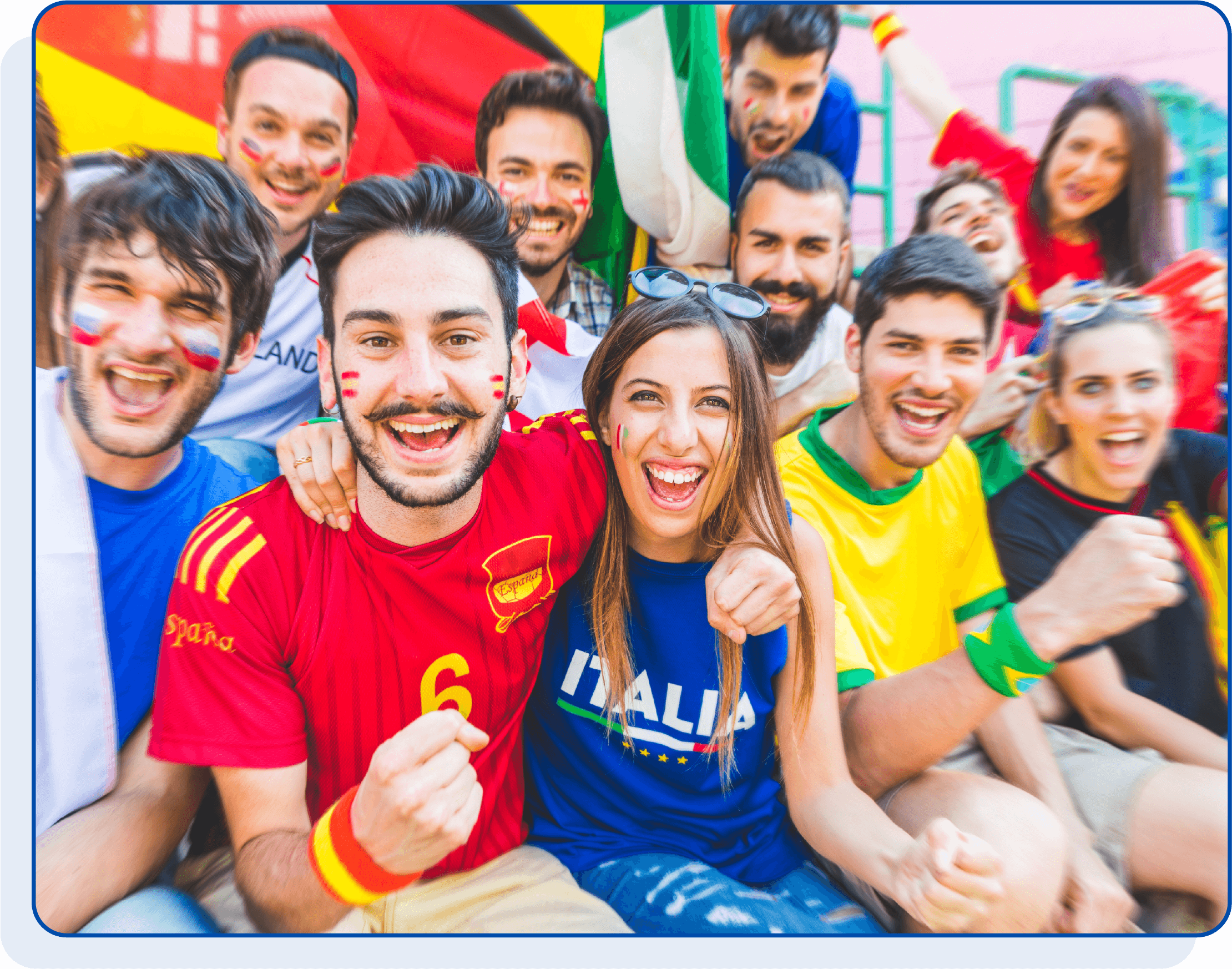
Five surfaces. Four days. One World Cup. And a conversion story that lives entirely in the gaps between platforms.
This is the 2026 FIFA World Cup fan experience—genuinely electric, distributed across every surface imaginable, the most exhilarating measurement puzzle the advertising industry has seen. The brands that can follow millions of such journeys end to end are the ones who get to know in August exactly what they bought, and what to buy next time. The rest will be guessing.
Fourteen Super Bowls Don’t Happen Overnight
The numbers attached to the 2026 World Cup don’t arrive quietly. WARC Media forecasts a $10.5 billion injection into the global ad market during the tournament quarter alone. Telemundo sold 90% of its inventory before December 2025, doubling its 2022 cycle and locking in what NBCUniversal calls “the largest deals in Spanish-language history,” with Anheuser-Busch, AT&T, Bank of America, Coca-Cola, and Toyota among the committed partners. Fox’s remaining linear packages carry a $5 million floor, matched by an equal streaming commitment, with the most premium packages running as high as $50 million. Together, Fox and Telemundo are projected to generate $850 million in combined World Cup ad revenue. That’s up from $385 million the last time the tournament ran in its usual summer window—a broadcaster haul that puts this tournament into Super Bowl territory for the first time in soccer’s American history.
FIFA projects that 6 billion people will engage globally
The scale behind the numbers is unlike anything the sport—or American advertising—has previously attempted. Forty-eight teams, 16 host cities in 3 host countries, 104 matches across 39 days. Before a single match was scheduled, FIFA announced that it had received 150 million ticket requests in the first 15 days of the draw phase—30X oversubscribed, and more requests than the total number of people who attended every World Cup match in the tournament’s 96-year history. FIFA projects that 6 billion people will engage globally (a billion more than Qatar 2022, itself the most-watched sporting event in history), with the final alone expected to draw 1.5 billion viewers. This is a figure that makes the Super Bowl, for all its cultural mass, look like a regional event.
Brand Innovators, which has tracked every major campaign activation heading into kickoff, dubs it “14 Super Bowls in one.” This isn’t hyperbole. Matches running simultaneously in Los Angeles, Dallas, Miami, Kansas City, and New York mean that different games are primetime in different markets at the same moment—a broadcast complexity with no real precedent in American sports history, and a media planning challenge that makes the Super Bowl’s single-game simplicity feel almost quaint by comparison.
A Marathon, Not a Sprint
The brands that committed early understood something important about this tournament: It rewards duration, not just presence. Chris Jones, VP of marketing at Anheuser-Busch for premium brands including sponsor Stella Artois, captures it precisely: “The Super Bowl is a sprint toward one day. The World Cup is more like a marathon and a monthslong journey of building excitement.” Ricardo Marques, SVP of Marketing for Michelob Ultra, tells Forbes, “This is a rare moment where global scale, cultural relevance, and commercial timing all align. But more importantly, it’s a moment fueled by fandom—something brands can’t manufacture, only tap into.”
These brands have bought more than a moment. They’ve bought a journey across six weeks and every surface the fan occupies, making the measurement question not just whether the investment works, but where along the journey it does, and what evidence exists to prove it. This is a different kind of question than the Super Bowl asks, and it demands a different kind of answer.
No One Called This Play
In June 2022, Apple signed a $2.5 billion, 10-year exclusive deal with Major League Soccer—every game, every market, no blackouts, the first major American sports league to go fully exclusive with a single streaming platform. Apple SVP Eddy Cue announced it with characteristic confidence: “No fragmentation, no frustration.” In a sports rights landscape fragmenting across Amazon, Peacock, ESPN+, and Netflix, it added one more destination for fans to find the game. Fast forward to the broadcast ecosystem that now distributes the 2026 World Cup across Fox, Telemundo, Peacock, Tubi, YouTube TV, and a dozen vMVPDs simultaneously, each generating separate data streams and capturing a different slice of a fan who moves among them.
That MLS was worth $2.5 billion to Apple in 2022 traces directly to a promise made in 1988 by a lawyer named Alan Rothenberg, who witnessed something unexpected happen at the Rose Bowl four years earlier. Rothenberg had printed 30,000 tickets for the 1984 Olympic soccer match. As he recounts in his 2026 memoir, closer to 50,000 people arrived. FIFA President João Havelange was in the stands, watching an American appetite for soccer that was genuine, enormous, and entirely unpredicted. In 1988, the United States won hosting of the 1994 World Cup, and Rothenberg—who became U.S. Soccer president and chairman of the organizing committee—pledged as a bid condition that a first-division professional league would follow. The 1994 tournament drew a record 3.6 million spectators and left a $50 million surplus that funded the U.S. Soccer Foundation, rescued a federation that had been functionally bankrupt, and inspired a generation of American players. MLS launched in 1996. Thirty years of growth followed and is still accelerating: Through the first three months of the 2026 season, MLS has averaged 7.9 million live viewers per week across streaming and linear platforms, a 62% year-over-year increase, as the World Cup builds toward its June 11 kickoff.
A Most Unlikely Assist
Two years before the Apple streaming deal, Apple TV+ launched a show about an American college football coach who doesn’t understand soccer. The premise was the punchline. Ted Lasso was nominated for a staggering 61 Emmy Awards across three seasons and built Apple’s cultural credibility in sports before the company had any sports rights to speak of. The authority preceded the commercial bet. One thing led to another in a way that nobody sitting in a writers’ room in 2019 was modeling on a spreadsheet.
Ted Lasso returns for Season 4 on August 5—six weeks after the World Cup final—now coaching a women’s soccer club in Richmond, on the same platform whose streaming ambitions he helped underwrite. The commercial infrastructure that produces 14 simultaneous Super Bowls in 2026 traces through a sold-out Rose Bowl in 1984, a $50 million World Cup surplus in 1994, Ted Lasso in 2020, and a $2.5 billion streaming deal in 2022.
The measurement complexity arrives by exactly the same logic: The sport earned its commercial density one surface at a time, one decade at a time, until the fan’s journey to the stadium merch stand has become the most richly layered conversion path in advertising. Rather than a problem, it’s evidence that soccer has fully arrived.
The Surfaces She Crosses
The journey our fan at SoFi Stadium makes from LAX to the merch counter leaves impressions on five surfaces across four days, and the $120 jersey she’s wearing is a conversion no single platform’s dashboard assembles into a complete story. The CTV impression and social click, check. The DOOH exposure at the airport and along the light rail corridor reaches her in the physical world, where few measurement stacks are designed to reach. The geofenced push logs a delivery. The in-stadium transaction is cash. Each platform sees a piece; none sees the arc.
She isn’t unique. The Trade Desk’s 2026 World Cup research across 14 countries finds Americans tracking the tournament across roughly three media channels simultaneously—streaming, social, and sports news in continuous parallel—generating cross-surface impressions as the natural texture of fandom. One hundred million Americans plan to follow it, approximately 4X the number who watched the 2022 final on Fox. And Numerator’s May 2026 survey reveals that 89% of those viewers plan to make a purchase related to their watch experience—a purchase-intent rate exceeding both the Super Bowl and Winter Olympics—with projected consumer spending of $7.5 billion across the tournament. The fan at the merch counter is the expected outcome of a well-executed tournament buy.
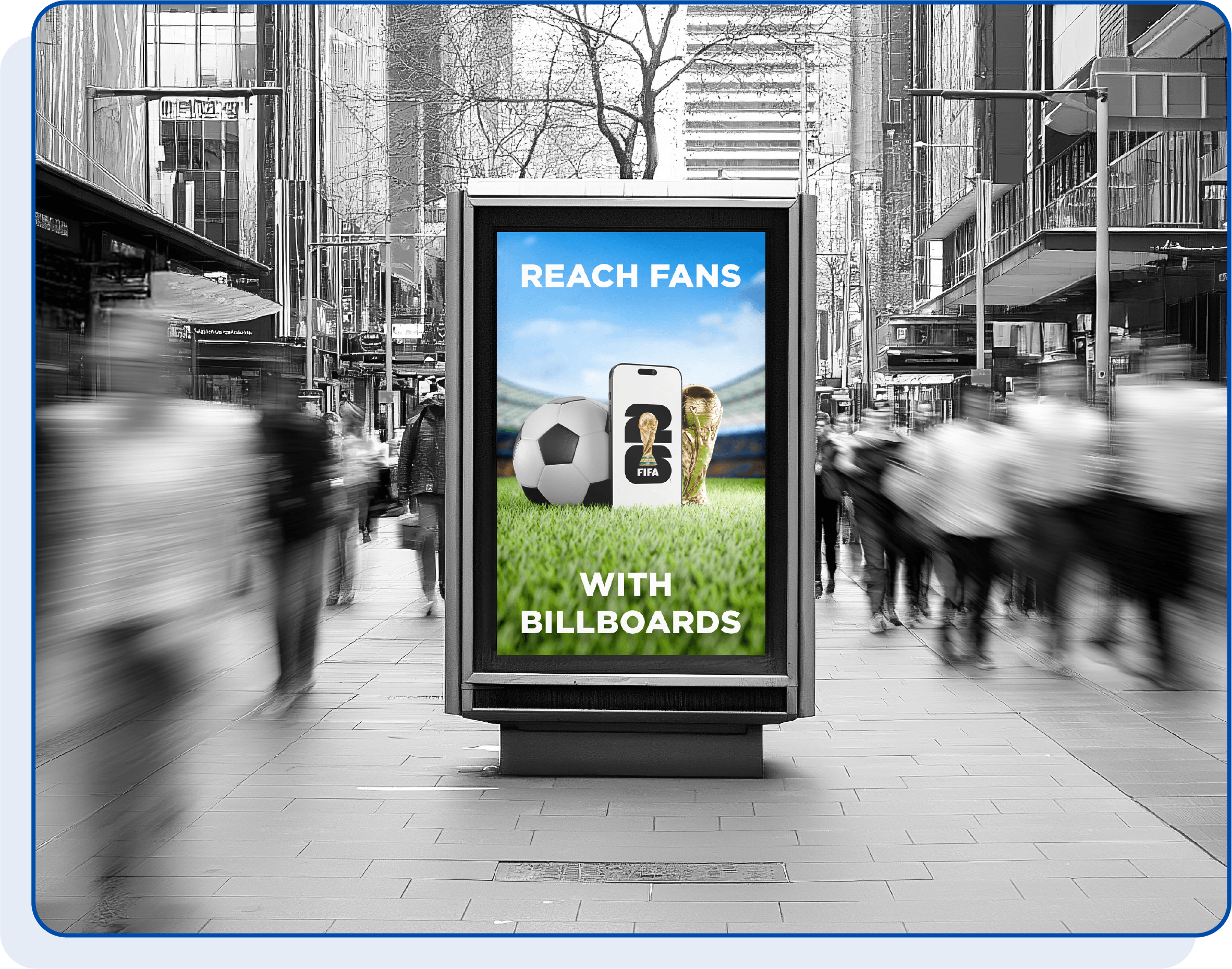
EMARKETER places total U.S. OOH spend at $11.3 billion in 2026—a 6% increase over 2025, driven directly by World Cup activation.
EMARKETER places total U.S. OOH spend at $11.3 billion in 2026—a 6% increase over 2025, driven directly by World Cup activation. Nielsen reports that out-of-home viewers—at bars, restaurants, fan zones, public spaces—accounted for more than 30% of match deliveries at last summer’s Gold Cup, a ratio expected to hold for the World Cup. Many of these users generate no device ID, no login, no addressable signal. They’re in the room, they see the ads. Most measurement stacks don’t know they exist.
Airbnb expects to house 380,000 guests across host cities during the tournament—more than any event in its history. The FIFA-WTO socioeconomic study projects 6.5 million in-person attendees across all 16 host cities, each moving through urban corridors, past brand inventory, generating impressions at every step.
The Gap That Matters Most
The in-venue surface is where the measurement ambition of any serious World Cup buy gets stress-tested most directly. Our fan who converts at a stadium merch stand almost certainly begins her journey on a digital surface days or even weeks before LAX. Connecting these impressions to this conversion—cleanly, causally, across the physical-digital boundary—is what separates the brands who know what they bought from the brands guesstimating in August. Digital Yield Group’s 2026 World Cup mobile analysis finds that fans are 49% more likely to make a purchase when they encounter a brand consistently across CTV, social, and mobile. The question is whether the stack can account for all of these.
What the connection requires is identity resolution that doesn’t stop at the browser: consented location intelligence matching a fan’s physical movement through a fan zone to a known digital profile, and measurement that treats the cash transaction at the merch stand not as an untraceable endpoint but as a conversion to work backward from. The IAB’s State of Data 2026 flags this physical-digital boundary as one of the least-solved problems in modern measurement. At this tournament, at this scale, it’s not an edge case, but the center of the puzzle.
Where the Hydration Break Changes Everything
Now consider the fan who isn’t in the stadium. He’s on his couch in Chicago or at a bar in Dallas, watching the match on Fox when the 22nd-minute whistle blows—not for a foul, but for a scheduled hydration break, FIFA’s first structured mid-match commercial window in tournament history, confirmed for each half of all 104 games. Broadcasters aren’t obligated to cut to ads—they can stay on the pitch or send it to the studio—but a full cutaway opens a 2’10” window to any advertiser willing to pay the premium. Fox and Telemundo are expected to cut. Streaming CPMs are forecast at $60 to $120 for World Cup coverage, with hydration break placements commanding near the top of the range.
He sees a spot. He opens his phone. He might buy.
This home viewer’s journey is entirely within the digital environment, where the thread is theoretically more followable, even as cross-platform reality complicates the stitching. Two fans, two journeys, one tournament. The question is whether the stack can follow both.
The Infrastructure That Follows the Fan
IAB’s State of Data 2026, published in February and drawing on more than 400 senior analytics and media decision-makers, puts the industry’s current reality plainly: 75% of buy-side leaders say their measurement underperforms on rigor, timeliness, trust, and efficiency simultaneously. Nielsen’s 2025 Annual Marketing Report—1,400 marketing professionals globally—finds only 32% measuring spending holistically across both digital and traditional channels. In Europe, this number falls to 23%.
The World Cup is the event at which the measurement gap’s consequences are most expensive. Forty-one percent of buy-side leaders believe CTV is underrepresented in their measurement models. In a tournament where CTV is the primary premium surface, that’s the central challenge of every serious buy.
The Wide-Angle Lens
Marketing mix modeling (MMM) has reemerged as the wide-angle lens this kind of complexity demands. EMARKETER reported that 47% of marketers planned to invest more in MMM this year, because privacy regulations and signal loss have made it the only full-funnel methodology capable of extrapolating the entire arc of a campaign, including the surfaces that leave scant digital trace. Their 2026 data captures how far the reversal has traveled: 28% of U.S. marketers now rate MMM as their most reliable measurement approach, compared to 19% for last-touch attribution (LTA). Three years ago, the numbers ran in the opposite direction.
MMM captures the cumulative impact of all marketing touchpoints across the entire customer journey while accounting for seasonality, competitive activity, macroeconomic trends, and events—the slower-building, deeper-running brand effects that touch attribution cannot see and which outlast the tournament by months. For a 39-day marathon buy distributed across a dozen platforms and 16 physical cities, that’s not a supplementary capability. It’s the frame that makes everything else interpretable.
The Marathon Needs Three Clocks
What MMM can’t do alone is follow the fan in real time or prove that a campaign or specific creative actually influenced what she did. That’s where LTA and incrementality testing earn their place as the instruments that sharpen and validate what MMM reveals. As Nexxen VP Kevin Maloy notes, “fragmentation is no longer an edge case; it is the operating environment”—which means that LTA’s job in this tournament is to maintain the thread of the fan journey across borders, platforms, and consent frameworks, supplying the granularity that feeds the aggregate model.
Incrementality testing then supplies the causal proof. The methodology answers not what happens across the campaign, not what it all adds up to, but whether the sequence of impressions across four days and five surfaces actually changes what the fan does—or whether she would have headed to the merch stand anyway. Incrementality is the layer that separates genuine lift from coincidental presence. In a tournament where WARC identifies the $10.5 billion as largely redistributed spend rather than net-new market expansion, this distinction is the question the CFO actually wants answered. MMM is the frame that makes the answer mean something.
The Final Whistle, and What It Reveals
MetLife Stadium, East Rutherford, New Jersey. July 19. The match ends. The trophy is lifted into the summer air by players who are celebrated across three countries simultaneously—in Seattle bars, Mexico City streets, Toronto living rooms, Los Angeles stadium plazas where fans who’ve inhabited this tournament for 39 days finally exhale. The fan with the Yamal jersey is somewhere, holding something she bought because of myriad impressions over multiple days and surfaces.
In August, the questions arrive: Which activations built the brand effects that won’t appear in any dashboard but will shape purchase behavior for the next two years? Which impressions were genuinely incremental, and which ones reached fans who were already on their way to the merch stand?
The brands with the measurement infrastructure to answer these—precisely, not directionally—are the ones who get to compound the tournament into something lasting. The intelligence built for 39 days of World Cup activation doesn’t stop being useful when the trophy is awarded. It becomes the playbook for every activation that follows: every tentpole, every season, every moment a brand has the chance to reach a fan at exactly the right instant on exactly the right surface.
Rothenberg’s Rose Bowl crowd in 1984 produced a chain that nobody fully planned and everyone eventually benefited from. The measurement infrastructure built for 2026 works the same way: Its value accumulates long after the final whistle.
The millions of fan journeys from airport billboard to stadium merch stand are unlike anything the industry has been asked to track before. The tools to follow it completely—MMM, LTA, and incrementality testing as a unified stack across CTV, mobile, DOOH, and in-venue conversion—exist. The only question is whether your infrastructure is working before June 11 or being assembled in pieces sometime after July 19. Kochava brings everything together in a single system built for exactly this kind of complexity. Contact our team for a measurement strategy huddle..