

Kochava Foundry > MediaLift
Incrementality Studies You Can Trust
Prove what actually drove results with independent, third-party validated lift measurement.

Incrementality Studies Delivered For

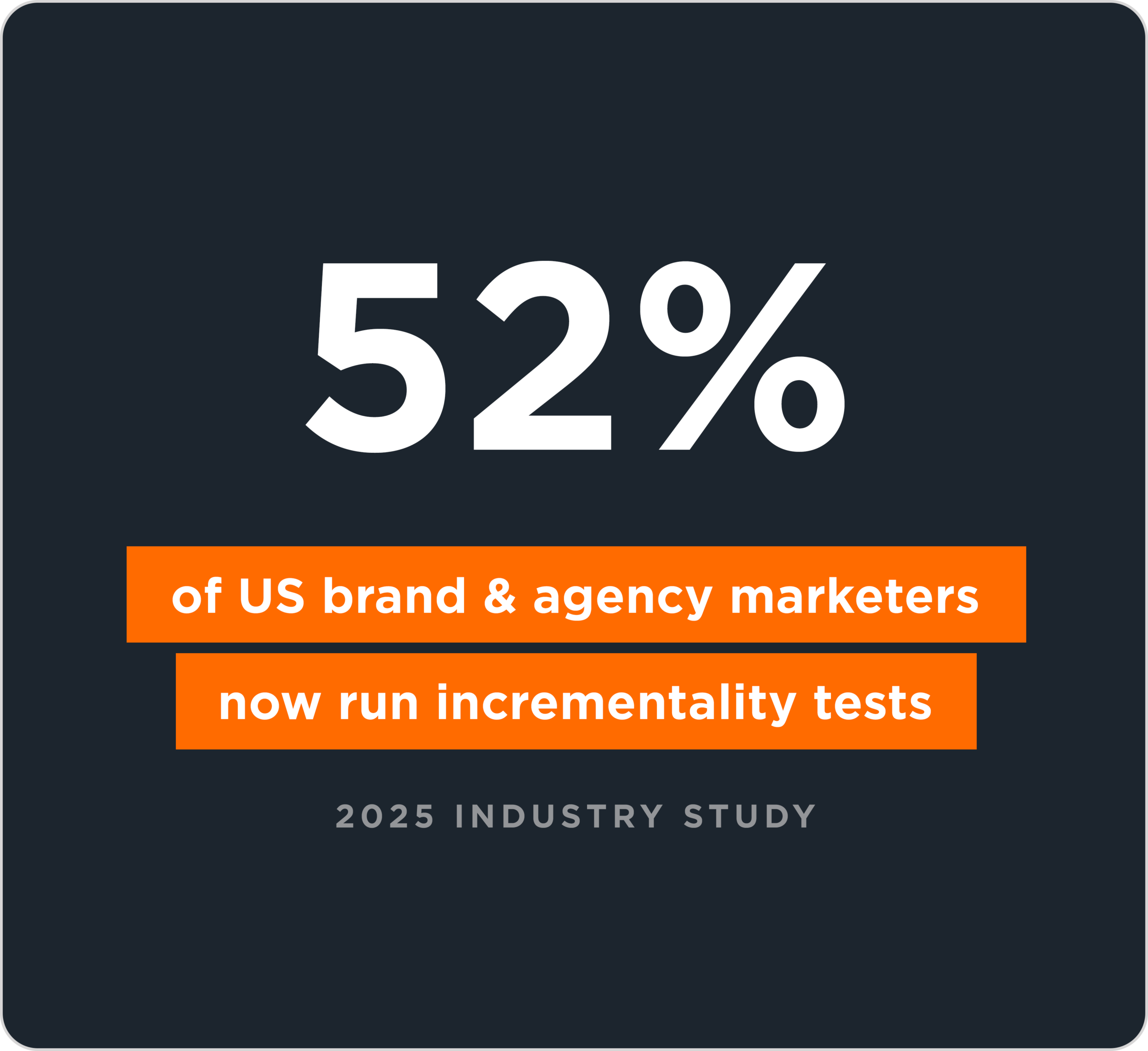
INCREMENTALITY IS EVERYWHERE
More Marketers Are Testing for Incrementality. Fewer Can Say They Trust the Results.
A recent industry study found that 52% of US brand and agency marketers run incrementality tests. But when the lift numbers come from the platform, agency, or publisher that sold the media, how do you know what to trust?
MediaLift® closes the gap with independent, third-party validated lift measurement.

Setting the Standard for Incremental Lift Measurement
MediaLift is powered by Kochava Foundry, the strategic services division of Kochava. It provides third-party validated, independent lift measurement using proprietary synthetic control group modeling to separate true causal impact from simple correlation.
No holdouts. No conflict of interest. Just the incremental lift your media actually generated.

Why MediaLift Is Different
MediaLift solves the challenges that make traditional incrementality studies unreliable or impractical.
| Common Challenge | MediaLift Approach |
|---|---|
Holdout groups sacrifice reach and revenue before a campaign even launches. |
No holdout required. Run your media freely. We build a synthetic control group after the fact with zero reach sacrifice. |
Standard attribution measures correlation and credit, not true causality. |
MediaLift measures actual incremental lift: what your campaign caused, not just who touched it last. |
Self-reported performance metrics create an inherent conflict of interest. |
Kochava Foundry® doesn’t sell media; it only measures it. MMP-agnostic and fully independent. |
Poorly constructed control groups introduce bias that skews results. |
A proprietary identity graph builds a forensic lookalike control group, removing unwanted bias from the comparison. |
Deprecated identifiers and privacy regulation are breaking legacy measurement. |
Privacy-forward by design. No reliance on deprecated identifiers, with clean room deployment available. |
Results arrive weeks after a campaign ends, too late to optimize anything. |
Actionable results in 5–10 business days, fast enough to inform your next media decision. |
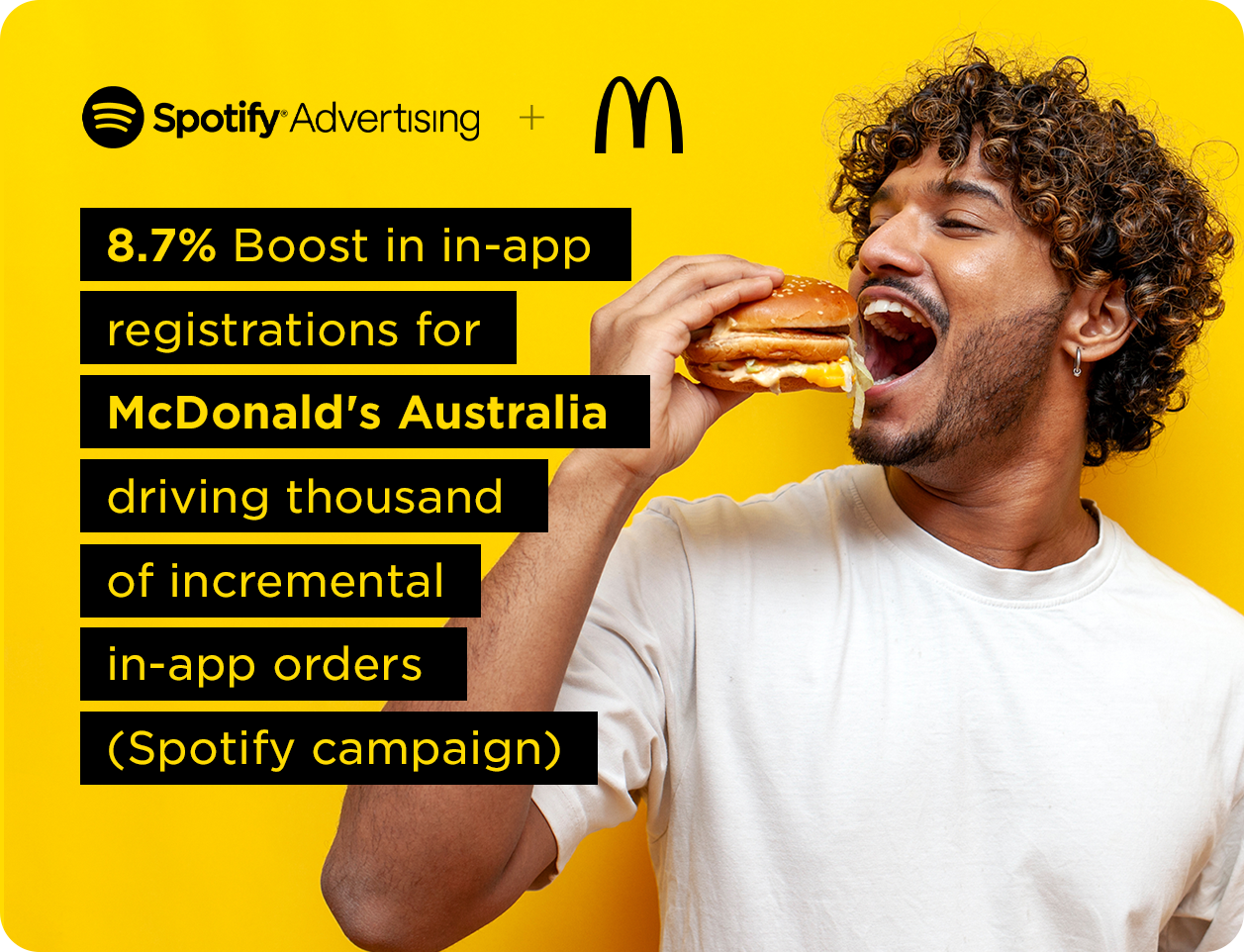
Incremental Lift From Real MediaLift Studies
21% lift on in-store retail purchase from a combined DOOH + online video (OLV) activation
15% lift in new subscriptions for a leading streaming service, measured via a CTV MediaLift study
16% boost in website conversions for a consumer health brand activation across DOOH + CTV
“This was such a uniquely tailored campaign strategy for McDonald’s, and we were thrilled Kochava Foundry was able to independently analyze the incremental impact of the effort.”
Advertising Research Manager, Spotify Advertising

How MediaLift Works
MediaLift’s proprietary synthetic control methodology fits naturally into any campaign, past or present.
1
Share Campaign Data
Impression and exposure data is onboarded from your campaign flight.
- No SDK required
- Compatible with any MMP or attribution provider
2
Model Synthetic Control
Proprietary identity graph models a forensic control group, removing bias from the comparison.
3
Analyze Lift
Downstream conversion behavior is analyzed between exposed vs. control groups.
4
Deliver Results & Insights
Comprehensive report includes executive summary, statistical validation, and strategic recommendations.

Incrementality for Any Channel
Measure true incremental lift regardless of where your campaign was served, across the full funnel, online and offline.
- Mobile
- Connected TV
- Linear TV
- D/OOH
- Streaming Audio
- Social & Programmatic
- DSP
Measure Lift for Any Outcome
From upper-funnel brand impact to bottom-funnel revenue events,
MediaLift can measure incremental impact for any outcome.

Upper Funnel: Awareness & Brand
Brand Recall
Brand Awareness
Ad Recall
Brand Consideration
Purchase Intent
Brand Recommendation
Mid-Funnel: Engagement & Interest
App Installs
Web Visits
Product Views
Tune-In/Viewership
Footfall Visitation
Lower Funnel: Conversion & Revenue
In-App Purchases
Subscriptions
In-Store Traffic
Ticket Sales
Offline POS Conversions
Reengagement
Ask about our growing ecosystem of data partnerships that enable MediaLift studies for advanced outcomes.

Consumer Purchase Data
Purchase receipt data for SKU-level transaction verification and retail conversion measurement

Theatrical Movie Ticket Sales
Movie ticket sales data for full theatrical funnel measurement, from trailer views to confirmed ticket purchases

Automotive Purchase Signals
Automotive registration data for dealer and vehicle purchase attribution
Frequently Asked Questions
Answers to questions marketers often ask about incrementality studies and incremental lift measurement.
What is an incrementality study?
An incrementality study measures the true causal impact of a marketing campaign by comparing outcomes between an exposed group and a comparable control group. It isolates results actually caused by the media from activity that would have happened anyway.
What is incremental lift and how is it measured?
Incremental lift is the percentage difference in a business outcome—such as web visits, app installs, or in-store purchases—between an audience exposed to a campaign and a statistically equivalent unexposed audience. MediaLift measures this using proprietary synthetic control modeling instead of a traditional holdout group.
How is incrementality different from attribution?
Attribution assigns credit to a touchpoint based on when a conversion happened, not whether the media caused it. Incrementality testing establishes causation by comparing exposed and control groups, showing what portion of results the campaign actually drove.
Do I need a holdout group to run a lift study?
No. MediaLift does not require a preplanned holdout or any sacrificed reach. Campaigns run normally, and a synthetic control group is modeled after the fact to measure lift without holding back media from any part of your audience.
How long does a MediaLift incrementality study take?
Most MediaLift studies deliver results in 5–10 business days after campaign data is received, fast enough to inform decisions on a current campaign or the next one.
Incremental Lift for All

For Advertisers
Understand the true incremental value of your media spend, especially across CTV, D/OOH, and linear TV where standard attribution often falls short.
Justify budgets with statistically rigorous, independent results and reallocate spend toward what’s actually working.

For Agencies
Prove the value of your strategy activations with independent, third-party lift validation.
Use MediaLift as a differentiator to show clients how your media efforts actually moved the needle, without building an internal data science team.

For Publishers & Platforms
Commission independent MediaLift studies to give advertisers credible performance validation.
MediaLift is trusted by streaming platforms, D/OOH operators, social platforms, and audio publishers to win and retain advertiser spend.
Get a MediaLift Incrementality Study for Your Next Campaign
Talk to Kochava Foundry about feasibility for your campaign: channels, outcomes, data requirements, timing, and deliverables. Studies are available as one-time engagements or as part of an ongoing managed services retainer.