
Unified Measurement Framework Drives 103% Subscriber Growth at 41% Lower CPA
Takeaways
✓ 41% Reduction in Cost Per Acquisition (CPA)
✓ 103% Growth in Subscriptions
✓ 92% Increase in Total Ad Spend
Customer
This leading lifestyle app offers consumers an intuitive way to organize life’s personal moments.
Challenge
With a sophisticated app marketing team, the brand was investing in both last-touch attribution (LTA) and marketing mix modeling (MMM) for a more holistic perspective of channel efficiency. These distinct measurement disciplines surfaced conflicting signals, forcing the team to evolve their approach to performance analysis and media mix optimization.
In one instance, the brand’s LTA data pointed to Google as a dominant driver of their paramount key performance indicator (KPI): 7-day first-time conversions on Android. Google appeared to shoulder an outsized share of conversions, justifying a significant slice of the media budget. However, when the team cross-referenced this view with their MMM data, the story looked quite different. MMM showed that Google’s incremental contribution was far more modest than LTA reporting alone suggested—and that upper-funnel channels were playing a pivotal, albeit uncredited, role in driving users to that final touchpoint prior to conversion.
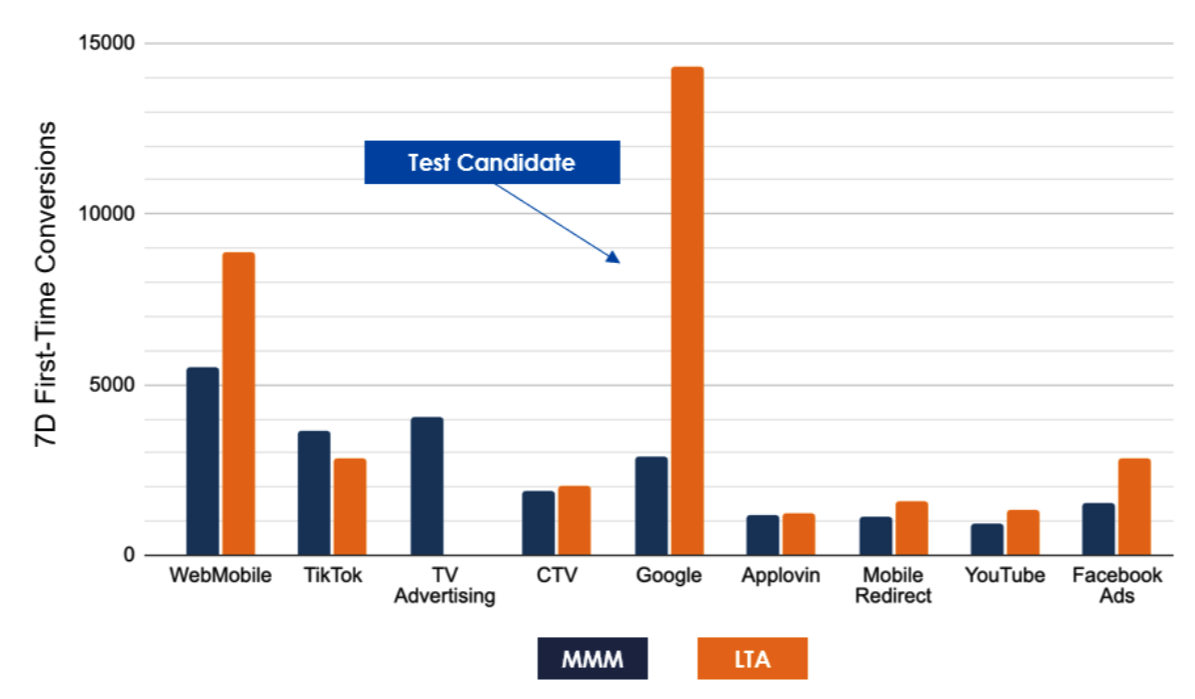
While last-touch attribution was correctly answering What was the last touchpoint before conversion?, it was never designed to account for full-funnel, cross-channel dynamics shaping a consumer’s path to purchase.
The team faced a strategic dilemma, as the marketers managing distinct lower-funnel vs. upper-funnel budgets debated over which data set should guide future spend decisions. The stakes were high: Continuing potential overinvestment in a channel based solely on LTA reporting could mean leaving real incremental growth on the table, underfunding channels that actually moved the needle.
Solution
Rather than choosing between LTA and MMM, the app marketing team—working closely with Kochava—reframed the objective. The goal wasn’t to pick “the right” measurement methodology. Each approach is designed to answer a different question and serve a unique purpose:
Last-Touch Attribution (LTA) provides fast feedback that’s ideal for lower-funnel channel management and real-time iteration. It can be used for day-to-day campaign optimization and A/B testing.
Marketing Mix Modeling (MMM) excels at evaluating cross-channel synergies and the point of diminishing returns—guiding investment decisions across upper-, mid-, and lower-funnel media.
When MMM and LTA produce differing outputs, a third methodology can be engaged as referee and validator:
Incremental Testing is perfect for controlled experiments to validate empirically what would actually happen to total business outcomes if spend was reduced or reallocated among channels.
Kochava assisted the app marketing team in activating an incremental pulse test.
Pulse Test Results
With MMM signaling that Google’s true impact was significantly lower than what LTA reported, the brand worked with Kochava to design and activate a pulse test. Google campaigns were cycled on and off at predefined periods while the team closely monitored 7-day first-time conversion events across the full Android user base.
- LTA-predicted conversion drop: ~2,500 first-time conversions
- Actual conversion drop observed: ~500 first-time conversions
- LTA overcredit factor: 5X vs. actual impact
- MMM prediction: Validated—MMM aligned closely with what actually happened
The results of the incremental pulse test were definitive: LTA was indeed overcrediting Google. Much of the demand Google captured at the bottom of the funnel was already created by upper-funnel media, specifically TV and other brand-building channels.
Armed with empirical validation, the team restructured their channel mix. Upper-funnel media received the investment recognition it deserved. Google’s budget was right-sized to reflect its true incremental role. Going forward, the team orchestrated investment decisions based on their MMM Insights dashboard in Kochava, while leaning on LTA data for rapid, campaign-level feedback and in-flight creative iteration.
Impact
By applying a triangulated measurement framework consistently over 12 months (March 2025 to March 2026), the brand saw results compounded in a way that no single-methodology approach could have achieved:
↓ 41% reduction in cost per acquisition (CPA)
↑ 103% growth in subscriptions
↑ 92% increase in total ad spend
The 92% increase in ad spend wasn’t an unplanned cost increase; it was a confident, data-driven decision to double down once the team knew exactly which spend generated the most incremental returns. Efficiency came first, then growth followed.
Key Case Study Takeaways
- LTA and MMM aren’t competing—they’re complementary.
Last-touch attribution is a precision tool for campaign-level decisions. Marketing mix modeling is a strategic tool for portfolio-level decisions. Using both in concert, validated by incremental testing, leads modern teams to find ground truth. - The truth lives in total business outcomes.
Channel-level metrics shouldn’t become the whole story. When running incrementality tests, measure what actually matters: total revenue, total conversions, total subscriptions. - Overcrediting a channel is a real cost.
Every dollar overattributed is a potential dollar not invested in upper-funnel media that actually generates demand. Measurement accuracy isn’t just an analytics exercise—it directly affects growth trajectory. - Confidence follows clarity.
When the team understood where their spend was effective, they didn’t pull back. They invested more. That’s what it looks like when measurement is truly working.
Ready to Find Your Ground Truth?
Kochava’s unified measurement framework—combining last-touch attribution (LTA), marketing mix modeling (MMM), and incremental testing—gives your team the clarity to measure what matters and invest with confidence.
”Honestly, the pulse test was the moment it all became real for us—we expected to see a huge drop when we paused, and our assumptions were inaccurate. That’s when we knew our marketing mix model needed to be our compass for spending investments.
Global User Acquisition Director