Different measurement tools give you different answers. Better decisions start with understanding how to use them together.
TL;DR Summary
Marketing measurement feels broken for most organizations, not because the tools are inadequate, but because no single methodology was designed to answer every business question. Last-touch attribution, marketing mix modeling, and incrementality testing each measure something distinct, and when any one is treated as definitive truth, poor decisions follow. The path forward requires agreeing on where ground truth actually lives (total business outcomes), assigning each measurement methodology a clear role, and using the evidence from all three in combination to make directionally reliable investment decisions.
A while ago, I was brought in to work with a sophisticated app marketing team. Sophisticated in the right ways: strong people, serious budgets, and genuine commitment to data-driven decision-making. They were also, to put it plainly, at war with each other.
The performance team managed paid search and social. By every measure they had access to, things were going well. Their last-touch attribution data showed Google delivering the highest share of 7-day first-time conversions on Android. The numbers were legible, consistent, and clearly pointed toward where the budget belonged. Their position was straightforward: The data supports this spend.
The brand and upper-funnel team saw an entirely different picture. They were running TV and brand-building media and had access to an internal marketing mix model that told a conflicting story. According to the model, Google’s contribution to actual business outcomes was far more modest than the attribution layer suggested, and the upper-funnel channels driving awareness and intent received little to no credit for the demand they were generating.
Neither team was wrong about what their data showed. Both, however, were treating their measurement output as the whole truth, when in reality each one answered a different question. The performance team used last-touch attribution, which assigns credit to the last eligible touchpoint before a conversion. This helps teams manage campaigns but does not establish whether that touchpoint caused the conversion. The upper-funnel team had a model that assessed contribution across the full media mix—a different question entirely.
The result was internal stalemate. Each team was responding to the targets and evidence in front of them, but they had no agreed way to resolve the disagreement. A significant monthly budget remained tied to an allocation the teams could not agree was justified, and investment decisions stalled.
I will come back to how the situation was resolved. First, I want to explain why this kind of conflict is so common, and why it is not, despite appearances, a people problem.
Four Reasons Measurement Feels Broken
When I ask marketing professionals how confident they are in the accuracy of their measurement, the answer is consistently discouraging. At a recent online webinar event, 100% of respondents said no when asked “Are you confident that your marketing measurement is accurate?” Independent research has arrived at similar findings: A CIMM and 4As study Kochava co-sponsored with Nielsen and TechEdge describes the dynamic as “the paradox of plenty”: more dashboards, more data, more reporting, and yet less actionable clarity. One CMO captured it simply: “We are drowning in dashboards. We don’t need another report. We need a single version of reality.”

“We are drowning in dashboards. We don’t need another report. We need a single version of reality.”
Interviewed CMO
Harvard Business Review Analytics Services finds 87% of marketers identifying MMM as important for data-driven insights, but only 28% report that their organizations effectively convert the insights into timely decisions.
The dysfunction is structural. In my experience, it has four identifiable root causes:
- A demand for certainty that no system can provide: Senior stakeholders frequently demand an answer to We put $1,000 in, so what exactly came out? We can record spend and conversions precisely. Establishing exactly how many of these conversions would not have happened without advertising is harder. Markets change, channels interact, and other factors affect demand. Good measurement helps us estimate marketing’s contribution and understand the uncertainty around it. When frameworks are evaluated against a standard of certainty they were never designed to meet, they’ll always appear to fail.
- Channel-level optimization that works against total business outcomes: Teams optimize toward whatever they are told to improve. A performance team with a channel-level CPA target focuses on that number. This is rational. The problem emerges when channel-level improvement diverges from total business performance. Improving CPA at the channel level does not automatically translate into improving sales, subscriptions, or revenue. I have worked with teams who consistently hit individual targets while total outcomes remain flat, and the conflict between the two realities rarely has a technical solution—because the issue is how success has been defined.
- Siloed teams that cannot see each other’s contribution: When teams managing different parts of the media mix operate in isolation, interactions among channels become invisible. Upper-funnel brand investment creates demand. Lower-funnel search and social capture it. Neither team recognizes the dependency; both are measuring the world through a lens that confirms their own contribution while obscuring everyone else’s. This is the dynamic that produces internal conflict, and what I watched play out with the team I described earlier.
- Overreliance on last-touch attribution as the default system: Last-touch attribution became the industry default because it is operationally accessible and easy to act on tactically. But it answers a specific and narrow question: Which touchpoint came last? It was never designed to explain what caused a conversion, what would happen if a channel was reduced, or how much of the demand converted was demand actually created. Treating last-touch data as the primary source of strategic investment truth leads teams to systematically overcredit bottom-of-funnel channels while the upstream activity feeding performance goes largely uncredited.
The Framework That Produces Better Answers
The teams I have observed navigate effectively share several consistent characteristics. They are not necessarily better resourced. They have made a set of deliberate structural choices or principles.
Principle One
Ground truth lives in total business outcomes.
Start with what the business actually achieved: total sales, subscriptions, revenue, and the overall cost of acquiring customers. Channel-level CPAs help teams manage campaign activity, but they should not define success in isolation. If every channel is hitting its target while the business is standing still, something needs questioning.
The total results tell us what happened. The measurement framework helps us understand how much marketing contributed and where investment should change. Giving every team the same business objectives creates a shared basis for decisions.
Principle Two
Focus on meaningful trends, not pennies.
CPAs fluctuate week to week and month to month. Seasonality, holidays, competition, and changes in customer demand all affect performance. A small movement does not automatically mean a channel has become more or less effective.
Yet teams can spend hours debating a few cents in reported CPA or changing budgets in response to a short-term fluctuation. The important question is whether we are seeing a sustained change that warrants action, once wider conditions and the uncertainty in our measurement are taken into account.
Successful teams still care about accuracy. They use it to distinguish meaningful signals from normal noise, understand where returns are weakening, and decide when to act. They do not need every number to reconcile perfectly before making a well-supported decision.
Principle Three
Triangulate: give each measurement method a clear job.
No measurement method gives us the complete answer. Successful teams use different methods for their strengths and triangulate the evidence. MMM sets investment direction and guardrails, attribution supports day-to-day optimization within the guardrails, and incrementality testing validates or challenges the assumptions.
Last-touch attribution (LTA) belongs at the tactical execution layer: the day-to-day management of campaigns within investment parameters that are already set. It provides fast, granular feedback that is genuinely useful for in-flight optimization and creative iteration. It is not the right instrument for determining strategic budget allocation across the full media mix.
Marketing mix modeling (MMM) operates at the strategic investment layer. It looks across the entire media mix, accounting for seasonality, promotional activity, and external variables, to identify where contribution is strengthening or weakening and where diminishing returns are setting in. The cost curve analysis it produces is particularly useful. The average CPA a platform reports via attribution and the model’s estimated marginal CPA—additional spend required to generate an additional acquisition at current spending levels—are frequently very different numbers. In practice, I have seen channels where the attributed average CPA was $189 while the marginal CPA exceeded $10,000. The model helps expose diminishing returns that an attributed average CPA can hide.
Incrementality testing helps validate or challenge our assumptions. Where attribution and MMM disagree materially, a well-designed test can provide additional evidence about a channel’s incremental contribution. Tests also have limitations, including statistical uncertainty and the conditions under which they run. Their findings should inform the next investment decision and help refine the model.
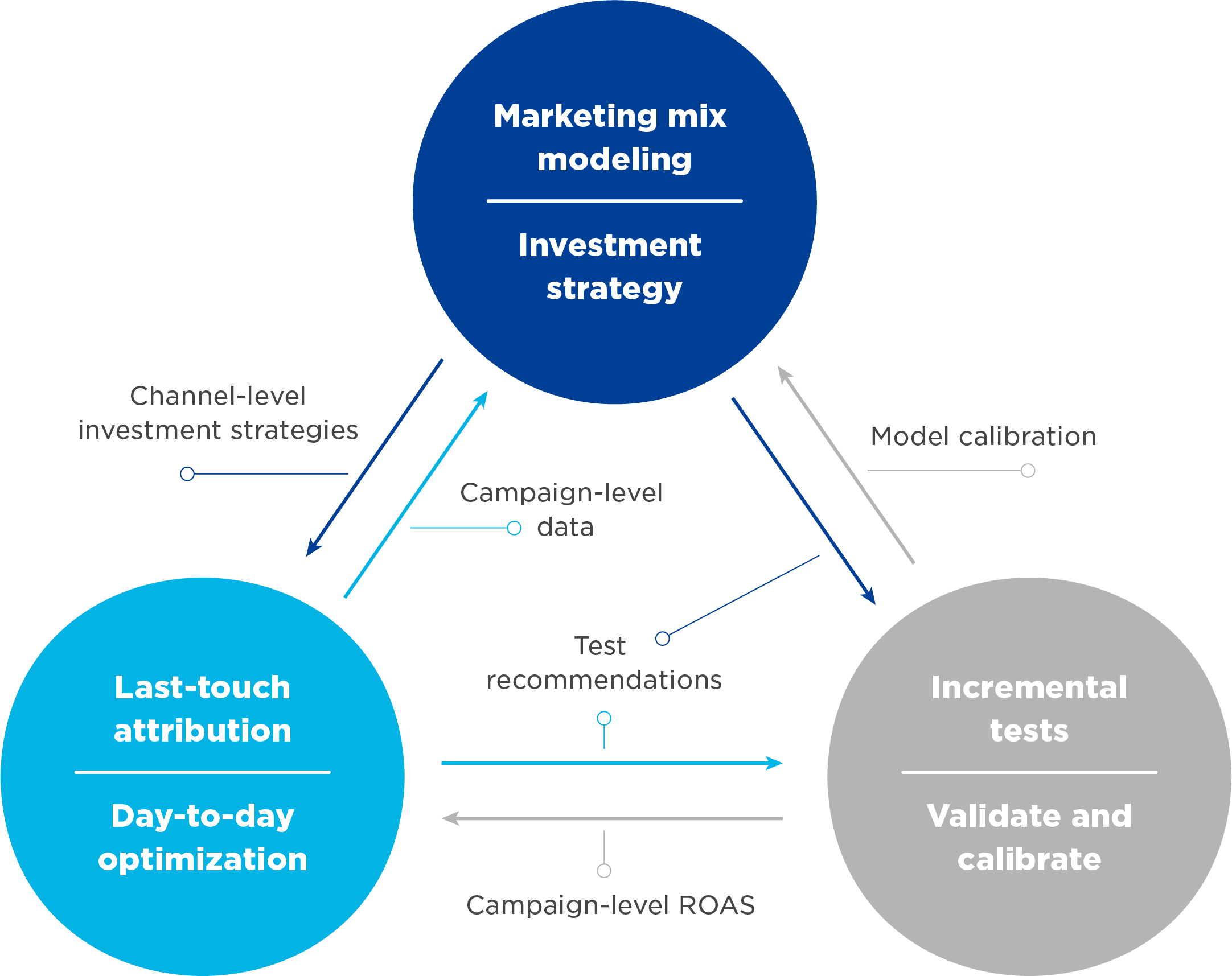
Working together:
- MMM sets the investment direction.
- Attribution executes within those guardrails at the tactical level.
- Incrementality testing validates and refines the assumptions.
Each compensates for the limitations of the others.
This is the approach behind AIM (Always-On Incremental Measurement), the marketing mix modeling platform by Kochava. We help teams use MMM alongside their existing attribution data and incrementality evidence to make better investment decisions.
Back to the Team That Was at War
 The standoff between the performance and brand teams did not resolve itself. Progress came when both teams agreed to run an incrementality test.
They agreed to use test findings as a shared basis for the next investment decision rather than continuing to argue from separate measurement outputs. Google campaigns were cycled on and off across predefined periods while the full team monitored total 7-day first-time conversions across the Android audience.
The test revealed a substantial gap. Based on Google’s attributed conversions, the performance team expected pausing the campaigns to reduce first-time conversions by roughly 2,500. The observed decline was less than 500. The findings were much closer to the MMM estimate, suggesting that Google’s incremental contribution was substantially smaller than its attributed contribution. Much of the demand it was receiving credit for appeared likely to convert without the Google activity.
The conclusion was not to abandon Google. It was to right-size it. The team restructured their investment to reflect what each channel was actually doing. Upper-funnel media received the budget recognition its contribution warranted. Google retained a focused, appropriately sized role in campaign execution. Over the following 12 months, applying a consistent, triangulated framework, the brand:
- Reduced cost per acquisition by 41%
- Grew subscriptions by 103%
- Increased total ad spend by 92%
This last figure is worth pausing on. Greater measurement clarity did not lead this team to pull back. It gave them the confidence to invest more, because they could now see, with a reasonable degree of certainty, where their investment would produce incremental returns.
This is what the framework is supposed to do. Not produce perfect numbers, but produce defensible ones that a team can act on together.
A Shared Basis for Better Decisions
Measurement feels broken when we expect one method to answer every question, judge teams against conflicting targets, or react to every small fluctuation as though it signals a fundamental change.
The way forward is to agree on the business outcomes that matter, distinguish meaningful trends from normal noise, and give each measurement method a clear role. The numbers will not always agree. What matters is understanding why they differ and using the evidence to make better decisions.
If your team faces these challenges, contact us to discuss how this approach could work for your business.
Watch the Full Conversation
If you want to go deeper on any of this, my colleague Rhiannon Taplin, a Sales Engineer on the AIM team, and I recently spent an hour unpacking exactly these ideas in a live webinar. We walked through the measurement framework, cost curves, and practical questions teams should be asking of their media mix. You can watch the full webinar on demand here.


About the Author
Gary Danks is Head of Product for AIM, the marketing mix modeling platform by Kochava. He has spent over 20 years in advertising measurement working with marketing teams across industries and geographies to clarify what their media investment actually contributes to business growth. Gary leads Kochava’s AIM platform, an integrated measurement framework that combines marketing mix modeling, last-touch attribution, and incrementality testing.
Connect with Gary on LinkedIn or contact us to explore how Kochava’s measurement framework applies to your organization.