What is marketing mix modeling?
TL;DR Summary
Marketing mix modeling (MMM) is a statistical method that analyzes chronological sales and marketing data to calculate the impact of various marketing efforts on sales and predict future results. The model quantifies channel effectiveness by identifying patterns in the relationship between marketing activities and sales outcomes while accounting for external factors like seasonality and channel saturation. MMM breaks down performance into three components: effectiveness (sales from each channel), efficiency (sales relative to cost), and return on investment (overall value gained). It enables marketers to optimize budgets by identifying the most and least efficient activities and simulate “what if” scenarios for future strategies.
Marketing mix modeling (MMM), also called media mix modeling, is a statistical method that analyzes time series data (chronological data) from sales and marketing. The goal of this analysis is to calculate the impact of various marketing efforts on sales and then predict the results of future strategies.
Think of it as a way of understanding the effectiveness of different marketing activities and how they each influence your sales. By analyzing your historical data, such as sales, the model quantifies the impact of your marketing channels. This is done mathematically by identifying patterns and trends in the relationship between marketing efforts and sales outcomes. To do this accurately, the model takes into account other market dynamics that affect sales, such as seasonality and channel saturation.
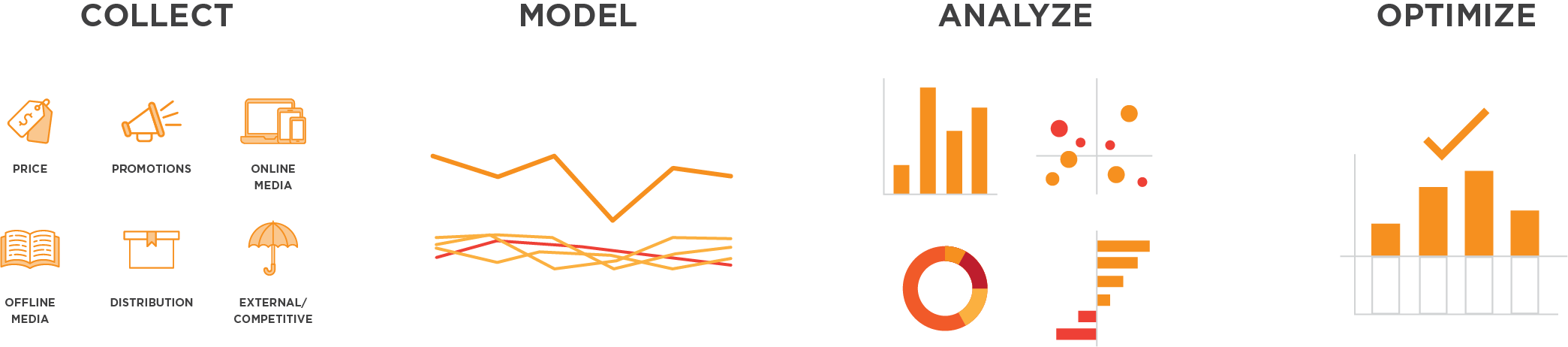
The success of each marketing channel can be understood by evaluating how much it contributes to incremental sales (e.g. sales that wouldn’t have happened if not for your marketing efforts). MMM breaks this down into three main components:
Effectiveness: This is about measuring sales brought in by each effort in a marketing channel. For example, if you post a new ad or increase spending, how much does that increase sales?
Efficiency: This focuses on comparing the sales generated to the cost involved in the effort. It’s about maximizing sales while minimizing the cost. In simpler terms, it’s ensuring that for every dollar spent on marketing, you realize the greatest impact on sales.
Return on Investment (ROI): This is the big-picture metric. It considers both the sales made and the costs incurred to give you an overall understanding of the value gained from your marketing efforts.
How to Get Started
Creating a marketing mix model involves training a model using historical data from sales, conversions, and ad spend derived from marketing efforts. This process is not just a science but also an art, striking a balance between automated modeling tools processing large data sets, and the detailed work of experienced data scientists. Multiple iterations are created to develop the most accurate model.
Why Use MMM?
MMM outputs can then be used to analyze the impact of marketing efforts on sales and conversions. For example, it allows marketing managers to see which elements contribute most to total sales, and the incremental gain in sales that can be obtained by increasing the use of a particular marketing channel. Importantly, it can also help in optimizing the marketing budget by identifying the most and least efficient marketing activities.
Finally, the model can be used to simulate various marketing scenarios in a ‘what-if’ analysis, which can help marketing managers make informed decisions about future strategies and investments.
Introducing Always-On Incremental Measurement (AIM): AIM is a cutting-edge MMM platform designed specifically to address the challenges faced by UA marketers. AIM’s unique approach leverages advanced machine learning that continuously adapts to new market information. The result? Precise insights that your UA buying team can take action on.
Want to know more? Get in touch here.
What is marketing mix modeling and what does it measure?
Marketing mix modeling (MMM) is a statistical method that analyzes time series data from sales and marketing to calculate the impact of various marketing efforts on sales and predict future strategy results. It quantifies how each marketing channel contributes to incremental sales—sales that wouldn’t have happened without the marketing efforts. The model identifies patterns and trends in the relationship between marketing activities and outcomes while accounting for market dynamics like seasonality and channel saturation.
What are the main components MMM uses to evaluate marketing success?
MMM evaluates marketing through three key components: effectiveness, efficiency, and ROI. Effectiveness measures the sales brought in by each marketing channel effort, such as how a new ad or increased spending impacts sales. Efficiency focuses on comparing sales generated to the cost involved, ensuring maximum sales while minimizing cost. Return on investment (ROI) is the comprehensive metric that considers both sales made and costs incurred to provide an overall understanding of value gained from marketing efforts.
How does someone get started with marketing mix modeling?
Creating a marketing mix model involves training a model using historical data from sales, conversions, and ad spend derived from marketing efforts. The process balances automated modeling tools processing large data sets with the detailed work of experienced data scientists. Multiple iterations are created to develop the most accurate model, which can then be used to analyze marketing impact, optimize budgets, and simulate various marketing scenarios in “what-if” analyses.
What is Always-On Incremental Measurement (AIM) and how does it help marketers?
AIM is a cutting-edge MMM platform designed specifically to address challenges faced by user acquisition (UA) marketers. AIM’s unique approach leverages advanced machine learning that continuously adapts to new market information, providing precise insights that UA buying teams can take action on. The platform represents a next-generation approach to marketing mix modeling with real-time capabilities.