The closed-loop attribution model ending the awareness-only era of entertainment marketing
TL;DR Summary
CTV has long been one of movie marketing’s most powerful mediums, though it has struggled to prove it. In a recent Kochava webinar, executives from Fandango, NBCUniversal, and VIZIO Ads unpacked how closed-loop measurement is changing this by connecting streaming impressions to Fandango’s purchase funnel, including the seat map signal that captures intent before a ticket is bought. The results from live campaigns—measured across more than a billion streaming impressions—establish CTV movie ticket attribution as a performance channel to rival search and social. The infrastructure is live with a growing cohort of CTV OEMs and tier-one publishers. Contact the Kochava team to learn more.
Friday Night, Row 3, Seats 10 and 11
Three weeks before opening weekend, a Wednesday night, on a couch somewhere in suburban America.
He’s midway through a streaming series when the trailer hits. Sixty seconds of score and spectacle, with a prominent release date. He sets the remote down, just knowing—the way you know when something is worth a Friday night and a babysitter—that he’s going to see this one in a theater.
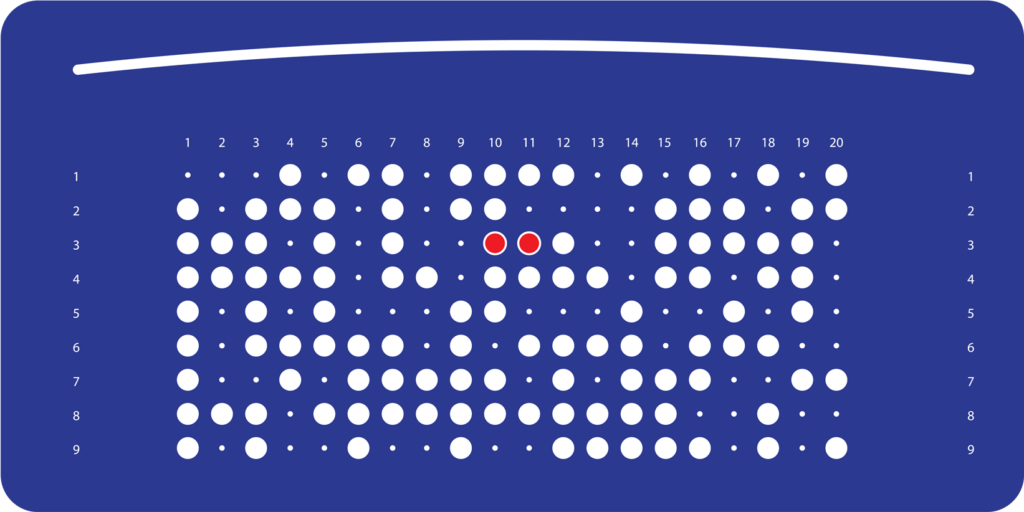 Over the next two weeks, the movie keeps finding him. A full-screen ad while he’s paused on the couch. A recommendation the following Saturday morning while he’s scrolling at the espresso stand. Come Thursday of opening week, he’s on a ticketing app, pulling up a theater seat map, picking two seats together in the center of Row 3.
Friday night, the lights go down. The sound hits before anything else. Two hours and change later, he knows it was worth the babysitter. Easily.
And somewhere in a dashboard he’ll never see, a chain of signals has resolved—the trailer, pause ad, home screen, seat map, ticket—connected and attributed, for the first time, all the way back to the screen that started it.
The Awareness Alibi
For as long as movie studios have bought connected television advertising, CTV’s role in the funnel has been treated as obvious but unverifiable. Trailers build excitement. Premium inventory drives consideration. Audiences show up. Everyone believes this; almost no one has been able to prove it.
The structural problem isn’t creative quality or audience scale, but rather the gap between impression and transaction. A viewer sees a trailer on a streaming platform Wednesday night. By Saturday—after two more touchpoints, a conversation with friends over coffee, and a search—they buy a ticket. Search gets the credit. Just because it happened to be standing at the door when the sale came through.
This is the last-click mythology that has quietly distorted entertainment advertising budgets for a generation. And it has a specific consequence: CTV, arguably the most contextually powerful medium for movie marketing, has been systematically undervalued because the infrastructure to connect exposure to outcome hasn’t existed. The result is a CTV movie ticket attribution gap that has quietly cost studios real budget clarity for years.
In April 2026, an expert panel convened by Kochava set out to unpack exactly how the infrastructure is now being built—and what it’s already proving. The session, From Big Screens to Every Screen: Modern Measurement & Outcomes in Entertainment Advertising, brought together Ryan Woodhatch, Sr. Director of Sales and Data Partnerships at Fandango; Mike Hood, SVP of Partnership Product Sales at NBCUniversal; Margaret Murphy, Sr. Manager of Media Insights and Analytics at VIZIO Ads; and Jason Howell, VP of Publisher Solutions at Kochava, to frame both the architecture of the solution and the stakes of getting it right.
What they describe isn’t a roadmap. It’s a working system.
The full session is available for viewing on demand—and well worth
the time.
The Declared Intent to Purchase
 Fandango has spent 25 years becoming the default infrastructure for theatrical ticketing, spanning 90% of US theaters and all major chains, processing the largest volume of digital ticket sales in the industry. This footprint creates something no other platform in the entertainment advertising ecosystem can offer: a deterministic view of the consumer at the precise moment they decide to go to the movies.
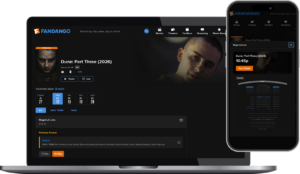
The signal that matters most inside this ecosystem is specific. Not the movie overview page, though that does matter; not the purchase confirmation, though that’s the finish line. It’s the seat map—the moment a viewer selects a showtime, opens a theater layout, and chooses where to sit. This is the action that represents declared intent. Woodhatch cites the data: 30–50% of the entire US box office reaches the seat map in their movie preplanning process.
Woodhatch explains that Fandango’s position at the point of purchase “allows us to connect that ticket sale to media exposures.” The goal, he adds, is to “expand that measurement to include CTV and other platforms, so studios and publishers can just become smarter about how they spend their dollars across these platforms.”
The seat map always knew who was going to show up. The question was whether anyone could connect it back to the screen that first inspired them.
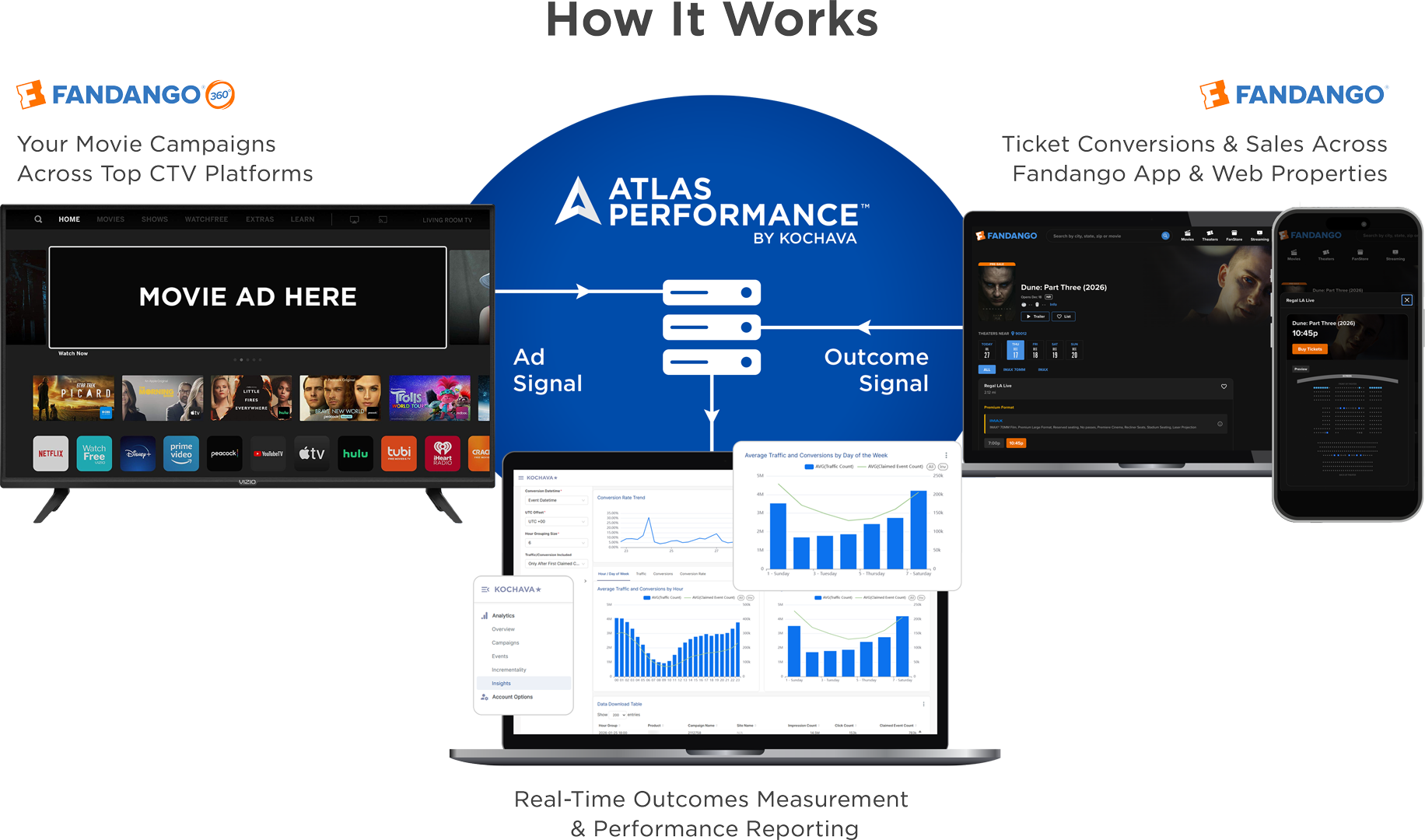
Atlas Performance by Kochava enables this connection. The framework creates a secure, dedicated measurement environment for each media partner—taking campaign impressions from a CTV publisher, mapping them against Fandango’s full funnel of conversion events, and attributing within consistent lookback windows applied uniformly across every partner in real time. When one publisher reports ROAS and another reports ticket purchases, they’re running through the same methodology. This uniformity turns individual data points into something a studio or agency can actually act on—and trust.
Howell frames the larger ambition simply: the framework is, for the first time, “giving these really important media partners access to that insight so they can ultimately make your campaigns perform better or partner more closely with you as a partner.”
CTV Movie Ticket Attribution: What 18 Months of Data Looks Like
NBCUniversal has been running this measurement framework with Fandango and Kochava for approximately 18 months—long enough to accumulate more than a billion streaming impressions, long enough to move from hypothesis to conviction.
The numbers challenged assumptions:
- A pause ad drove over $7 in box office revenue per dollar invested.
- Live sports streaming, casting the widest possible net with minimal audience targeting, delivered a strong positive return.
- Fandango360-targeted placements, which reached audiences algorithmically scored on their propensity to attend a specific film, performed at the top of the range.
- Across formats, ROAS figures ran upward of $9 of ticket revenue per ad dollar spent.
Hood explains what the data reveals about live sports specifically: “It casts the widest net possible—it reaches everybody. You might not have as high a return on ad spend because you’re not hypertargeting, but you’re building upper funnel in a really strong way. We’re really pleased with having a positive return on something that broad and mass reach.”
VIZIO Ads entered the partnership more recently, activating audience targeting across its home screen and CTV inventory—genre viewers, previous moviegoers, audiences with demonstrated affinity for similar titles—then measured users through the Fandango funnel to seat map views and purchase confirmations. The result: $3.53 returned for every dollar spent; 70K+ ticket purchases directly attributed to CTV exposure.
These aren’t projections. They’re results from live campaigns, with real audiences and real opening weekends on the line.
“You do not have to choose between performance, brand awareness, and premium. They should be living together.”
Mike Hood, SVP, Partnership Product Sales, NBCUniversal
From Campaign to Partnership
Here’s where the data story becomes a strategy one.
The measurement framework is valuable, and the ROAS figures are compelling. But the webinar speakers made clear that the more significant shift isn’t in what gets measured—it’s what gets built once you have something to measure.
Studio marketing teams previously operating in separate silos—awareness buyers and performance buyers rarely intersecting—can now build full-funnel strategies together. A high-profile show sponsorship that drives awareness for a specific title can now be measured alongside the retargeted campaign that converts the awareness into ticket purchases. A horror film behaves differently than a prestige drama. A tentpole opening ticket sales 8 weeks out behaves differently than a midtier title whose sales spike the Wednesday before opening. Data accumulated across multiple campaigns reveals the playbook—by genre, audience profile, release window—in a way no single campaign ever could.
Murphy describes what this looks like in practice: VIZIO Ads is building learning plans with studios at the start of each year, designed to “inform not just the next movie, but the next year’s movie” as well. She adds that the publisher worth building with is the one you can plan with—the one that hands you data designed to inform the next decision, not just justify the last one.
The data also answers a question studios should be asking: Do we keep on advertising after opening weekend? If an audience segment shows Fandango intent signals—seat map visits, movie overview page engagement—but doesn’t convert before opening weekend, that isn’t a failed campaign. It’s an unconverted audience with documented interest. Hood describes the approach deployed with select studio partners: identifying those who showed propensity but didn’t buy, then reengaging them the following week. “Let’s market to them for the week after opening,” he notes. “You still have to make that huge opening weekend splash. But being surgical about using data and this measurement gives you an extra crack at the plate.” The infrastructure to do exactly that now exists.
Trust, it turns out, is also a measurement issue. When every partner in the ecosystem is measured through the same independent third party with the same lookback window, comparisons become meaningful. Studios can evaluate media mix decisions based on real signal, not self-reported claims. Hood adds the human dimension: “Don’t be afraid to learn together and to fail, and be transparent and candid about when something didn’t work. That can lead to just as powerful a partnership as sharing only the cream of the crop, the best performance.”
What Studios Should Be Asking Media Partners Right Now
If a media partner can’t provide closed-loop attribution tied to Fandango conversion events through an independent third party, ask why. The infrastructure exists. The partners using it are getting ROAS data at the placement and creative level, with consistent methodology across the ecosystem. This accountability is now available. Anything less is the old model that put last-click mythology in charge for so long.
The Seat Map Was Always Talking
The man in Row 3, Seat 11 never thinks about attribution. He wonders only whether the movie is worth seeing on a Friday night. The trailer he sees Wednesday convinces him that it is. The pause ad reminds him. The home screen nudges him. The seat map seals it.
This journey has been invisible to the studio making the film—until now. The signal has always been there. The infrastructure just needed to catch up.
And the infrastructure now exists. It’s live, independent, already rewriting the performance narrative for theatrical advertising. The question for studio marketers isn’t whether CTV can be held to performance standards.
It always could. The seat map always knew.
Close the Loop on Your
Theatrical Campaigns
The closed-loop measurement framework connecting Fandango’s conversion data to CTV impressions—unified through Atlas Performance by Kochava—is live and in market across a growing roster of premium video partners, including NBCUniversal and VIZIO Ads.
Watch the full webinar on demand
Learn more about Atlas Performance by Kochava and CTV measurement for entertainment
Ready to see what this looks like for your campaigns? Connect with our team