Balancing last touch, MMM & incremental testing for ultimate ground truth
TL;DR Summary
Does your attribution feel broken? Focusing only on channel-specific performance or individual measurement methodologies leads to confusion and missed opportunities. Instead, the most successful teams combine last-touch attribution, marketing mix modeling, and incrementality testing to align everyone on total business outcomes, not just individual channel wins. Learn why unifying your measurement framework is essential and how Kochava helps you measure what matters, optimize what works, and maximize results.
Measurement Dilemma: Why App Marketers Are Struggling
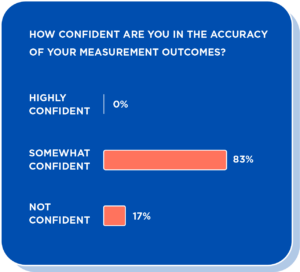 If you ask most app marketers how confident they are in the accuracy of their measurement, you’ll get a familiar answer: “Somewhat confident—at best.”
In a recent webinar poll conducted by Kochava, app marketers were asked, “How confident are you in the accuracy of your measurement outcomes?” The results speak for themselves: 0% of the audience chose “highly confident.”
For all the martech stacks, data dashboards, and advanced toolsets that companies have built, true confidence in marketing measurement remains surprisingly elusive. And that’s not for lack of effort.
According to a March 2026 CIMM/4As research study, The Paradox of Plenty: Advertisers’ Perspectives on the State of Measurement, “confidence in media and marketing measurement has not advanced at the same pace as measurement capability itself.”
This isn’t simply a data problem. In fact, most marketers acknowledge that the “paradox of plenty”—more data and dashboards than ever—isn’t about data accuracy but the struggle to reconcile competing signals across siloed systems and methodologies. As one interviewed executive put it: “We’re drowning in dashboards. We don’t need another report. We need a single version of reality. Everything is technically measurable, but none of it lines up without a lot of manual reconciliation.”
The ultimate reality? Most teams face measurement fragmentation that stifles progress. Different teams optimize different channels—one team focused on paid search and another on social, while others handle connected TV (CTV) or even offline channels. Each uses its own set of metrics, technologies, and sometimes, entirely different measurement methodologies. The result is a patchwork of channel-level “optimization” that rarely adds up to a true, unified picture of what’s actually driving real business outcomes.
 Roots of the Confidence Gap
- Channel silos: Marketing organizations divide responsibilities by channel: search, social, CTV, offline, and more. Each team chases its own goals in isolation.
- Noisy ecosystem: Consumer touchpoints are more numerous and fragmented than ever. Multiple influences surround every conversion.
- Signal loss: Privacy changes, platform restrictions, and evolving consumer behavior add noise, making it harder to see the true lift from any marketing activity.
- Measurement misalignment: Different teams use different methodologies: last-touch attribution, marketing mix modeling (MMM), or incrementality testing, focusing on what works for “their” channel, not the organization as a whole.
The outcome? Teams feel pressure for answers, yet the numbers don’t seem to add up, leaving marketers “somewhat confident” and hesitant to advocate for bold investments.
The Cost of Chasing “Perfection” at the Channel Level
For years, marketing teams grew accustomed to deterministic measurement—attributing each conversion to a single action or touchpoint. It felt like a ground truth, a source of comfort. But as the landscape has changed, the foundation has proven less reliable.
When each channel is fighting for its own optimization and budget, the business loses sight of what matters most: total business outcomes.
What High-Performing Teams Do Differently
What can organizations and their marketing teams do to address this confidence gap and fragmentation across channels and measurement methodologies? High-performing teams consistently align on three key principles.
Principle 1: Truth Lives in Total Business Outcomes—Not Just Channels
The best marketing teams stop asking, “Which channel won?” and start asking, “Did the business win?” They frame all measurement around outcomes that matter: total revenue, new users, subscription growth—not isolated channel metrics.
Deterministic attribution is still useful, but it tells you what happened last—not necessarily what caused growth. Focusing on the whole business is the only way to find true alignment and ensure that efforts across teams compound toward a single goal.
Principle 2: Direction Matters More Than Channel Precision
In a world full of noise, perfect precision is impossible—and that’s okay. High-performing organizations look at trends over time, asking, “Are our total results moving in the right direction?” They understand that occasional upticks in channel CPAs or confusing dips in conversion share are less important than the trajectory of total business performance.
The key is to keep a long-term perspective. Deterministic metrics are excellent for fast feedback, A/B testing, and campaign-level optimization. But when teams obsess over minute fluctuations or try to explain every outlying datapoint, they lose sight of the bigger picture.
Principle 3: Use Multiple Methodologies—Triangulate for Clarity
There is no “one-size-fits-all” metric in modern marketing. Single-source solutions have strengths—but also well-known blind spots:
- Last-touch attribution (LTA): Great for campaign execution and near real-time feedback, but fails to account for upper-funnel and cross-channel influence.
- Marketing mix modeling (MMM): Provides holistic, channel-level and offline media insights, answering strategic “where to invest” questions, but is less useful for daily optimization or creative-level feedback.
- Incrementality testing: Acts as an essential referee, helping validate other methodologies when channel signals conflict, but is limited to specific regions, time frames, or testable inputs.
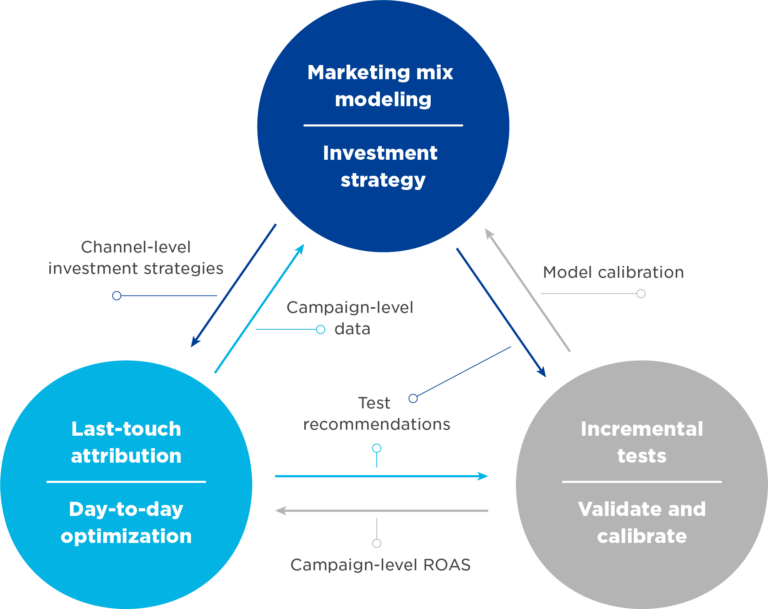
Elite teams use these methodologies together in a unified framework, triangulating their measurement for shared truth and organizational confidence.
Building the Unified Measurement Framework
Here’s how the highest-achieving marketers structure their measurement practice:
- Use MMM to set channel-level strategy (investment allocation and efficiency curves).
- Rely on LTA for day-to-day optimization within the boundaries set by overall strategy.
- Apply incremental tests regularly (e.g., quarterly or during major channel upheavals) to validate modeling and build organizational trust.
Each methodology informs and improves the others. Together, they provide the closest thing to “ground truth” in a world where certainty is no longer available from any single tool.
Real Results: The Proof Is in Unified Measurement
A major mobile-first brand doubled its ad spend in 12 months, growing total subscriptions by over 100% while slashing CPA by 44% (iOS) and 39% (Android). How? By aligning every team around a connected measurement framework. Instead of chasing conflicting signals and internal debates over whose numbers to trust, they let their systems work together—building confidence, resolving discrepancies with incrementality tests, keeping every eye on the total outcome.
When teams use measurement this way, something transformational happens: Measurement stops feeling broken and starts empowering growth.
Call to Marketers: Unify to Win
The adtech landscape isn’t going to get less complex. Channels and user journeys will proliferate, privacy rules will tighten, and internal pressures for results will only grow. The answer is not to add more dashboards or double down on a single methodology, but to pursue a unified measurement framework to cut through the noise.
This shifts the conversation from “Which channel performed best?” to “How do all our efforts combine to drive business outcomes?” It aligns everyone—from marketing operations to executive leadership—around results that matter.
For a deep-dive discussion on this topic, tune in on demand to our recent webinar Fixing Broken Measurement: The Marketers Playbook for MMM, Last Touch, and Incrementality.
How Kochava Can Help
At Kochava, we’re more than just a technology provider—we’re your partner in building, implementing, and evolving a modern, unified measurement approach. Our tools empower your teams to combine the strengths of multi-touch attribution, marketing mix modeling, and incrementality testing—delivering clarity, trust, and measurable growth that can’t be found in silos.
Stop settling for “somewhat confident.” Start measuring what matters, optimizing what works, and producing outcomes your whole business can celebrate.
Ready to unify your measurement? Connect with Kochava and see how you can transform uncertainty into opportunity today.
FAQ
Why isn’t channel-level measurement enough for app marketing success?
Channel-level metrics provide only a narrow view of your marketing performance. Today’s customers interact with brands across many platforms and devices, making it difficult to determine what’s really impacting business outcomes. Focusing solely on individual channels can lead to fragmented strategies, missed opportunities, and an incomplete understanding of true marketing effectiveness. A unified measurement approach brings all channels together, giving a holistic view of what’s driving growth.
How do last-touch attribution, marketing mix modeling, and incremental tests complement each other?
Each methodology has unique strengths and limitations. Last-touch attribution is excellent for real-time campaign optimization but can miss the bigger picture. Marketing mix modeling (MMM) offers broad, strategic insights across all channels—online and offline—but is less granular for day-to-day execution. Incremental tests serve as a valuable referee, helping validate and calibrate both attribution and modeling results, especially when there are conflicting signals. Combining all three yields a more accurate, actionable understanding of marketing’s true impact.
How can Kochava help my organization implement a unified measurement strategy?
Kochava brings advanced technology and expert support to guide your measurement transformation. Our comprehensive platform enables you to integrate last- and multi-touch attribution, MMM, and incremental testing, breaking down silos and empowering your teams to make confident, data-driven decisions. Contact us for a consultation.