Insights & takeaways from Kochava webinar featuring Meta
TL;DR Summary (click to expand)
Marketers already use AI for creative production and campaign work, but many are still cautious about letting it act on sensitive campaign settings or spend. In Kochava’s recent webinar with Meta, attendees identified data privacy and governance as the leading barrier to broader AI adoption in their workflows. Learn how a governed AI harness connects approved models, tools, and data so agents can monitor performance, explain what changed, recommend next steps, and support controlled action under close human review.
Watch webinar on demand | Create a Free StationOne account | Explore Media Buying Workspace for Meta
AI is already showing up in campaign work. But what happens after the first use case?
At Kochava’s recent Going Agentic webinar with Meta, the conversation centered on the next phase: moving beyond isolated prompts and creative generation toward AI agents that securely connect to the systems where marketers plan, launch, measure, and optimize campaigns.
The session brought together Kimberly Manning, VP of Marketing at Kochava; Hamilton Radcliffe, Head of Product for StationOne by Kochava; and Andrew Kutsy, Product Manager at Meta. The takeaway is clear: Marketers do not want another disconnected tool. They want a practical performance teammate, one that can monitor an account, explain what matters, recommend the next move, and help carry the work through with the right controls.
AI Is Already in the Workflow—But Adoption Is Uneven
We asked attendees where AI shows up in their campaign work today. The results reflect a market actively experimenting rather than moving at one uniform pace.
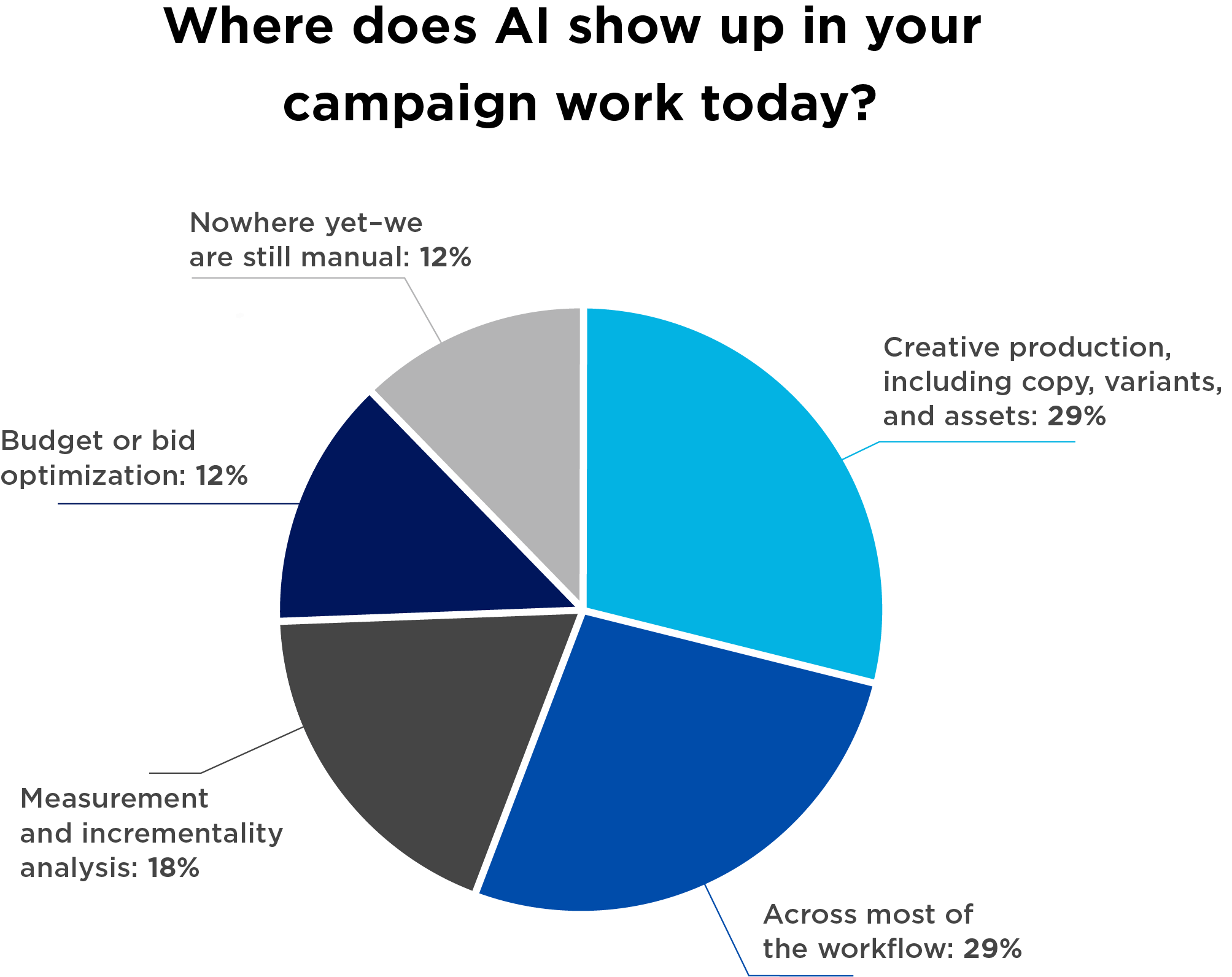
The equal adoption of AI for creative production and broader workflow tasks highlights its growing role. For many teams, AI has become useful in discrete tasks such as developing copy or creative variants. For another meaningful group, it is beginning to influence a much broader set of responsibilities.
At the same time, direct optimization remains more cautious. Only 12% of respondents selected budget or bid optimization. This reflects a familiar reality: Teams may be comfortable asking AI to analyze, summarize, and generate, while still wanting more confidence before letting it act on spend or campaign configuration.
What Marketers Would Ask an Agent to Do First
We asked registrants a simple question in advance of the webinar: If you had an AI agent for your Meta ads today, what is the first thing you would have it do?
Across numerous responses from growth marketers, media specialists, creative leaders, ad operations teams, executives, analysts, and technical practitioners, a consistent picture emerged. Marketers are not looking for a novelty chatbot. They are looking for help with the work that consumes time, fragments attention, and delays good decisions.
The responses clustered around seven connected needs:
 Find the next best optimization opportunity: Marketers want help identifying which audiences, creatives, or campaign settings are producing results—and where a change could have the greatest impact.
- Monitor performance and explain what changed: One respondent asked for a “what’s happening and what needs attention” system. Others want anomaly detection tied to spend, CPI, CPA, ROAS, conversion rates, and creative performance, with a clear explanation of what drives the movement.
- Make creative learning operational: Teams want to manage creative tests, spot fatigue, rotate assets, understand what winning creative teaches them, and turn these learnings into the next brief or variation.
- Reduce campaign operations overhead: Campaign setup, budget configuration, account audits, media buying, and recurring adjustments are all common requests where automation could play a big role.
- Optimize toward real business outcomes: Responses include audience recommendations, retention analysis, conversion comparisons, and using post-install signals such as purchases and retention—not only clicks or installs—to inform bidding.
- Connect the wider marketing stack: Marketers want to combine ad-account performance with audience planning, social listening, customer conversations, zero-party intent, and downstream measurement.
- Build confidence through transparency: They want to understand why a recommendation matters, compare approaches, and validate that AI is saving time or improving the quality of a decision.
Taken together, these responses point to a broader shift. The desired agent is not just a conversational interface, but also an operating layer that can bring context together, help marketers reason through complexity, and shorten the distance from insight to action.
Why Governance Is the First Real Adoption Challenge
The webinar’s second audience poll made the central headwind unmistakable.
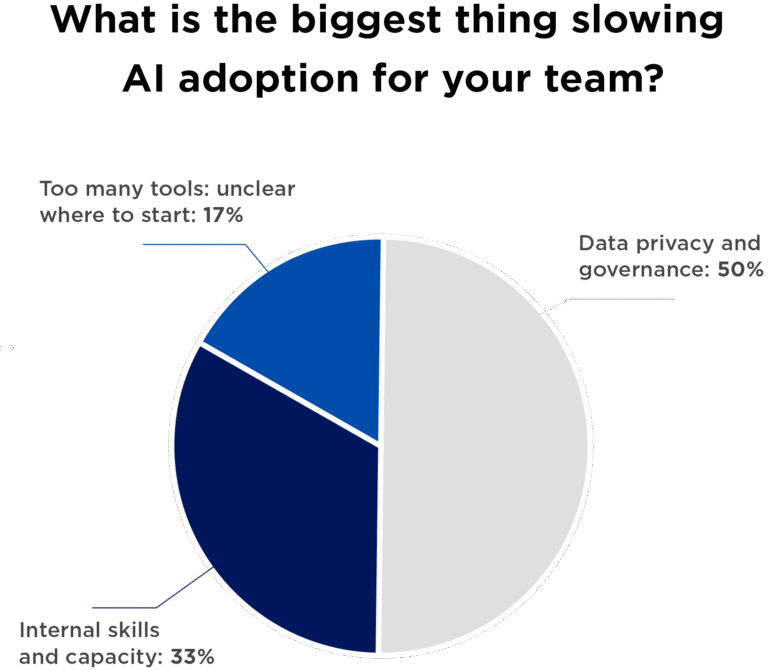
Half of respondents identified data privacy and governance as their top barrier. Internal skills and capacity followed at 33%. The message is clear: Marketers see the potential. They need a manageable way to put AI data privacy into practice and alignment with infosec teams, who are themselves scrambling to sort out governance requirements for their organizations.
That is where an AI harness fits. As Radcliffe explained during the webinar, an AI harness is the layer between the user, large language model, and systems a team needs to work with. It is designed to bring models, connectors, workflows, controls, and organizational governance into one operating environment.
A well-designed harness helps solve practical adoption challenges:
- Model choice: Teams can use the model that best suits the work instead of committing every workflow to one provider.
- Connected context: MCP connectors let agents access approved tools and data sources instead of relying on a single, disconnected chat experience.
- Governance: Organizational guardrails can help prevent sensitive information from being shared before it reaches an external model.
- Controlled access: Teams can manage which tools and actions are available, including a read-first approach before enabling approved write actions.
- Repeatability: Workspaces, skills, agents, and assistants help teams turn useful experiments into shared, governed workflows that can be executed across the larger organization.
This is why governance should not be treated as a reason to delay experimentation indefinitely. It is the foundation that allows teams to experiment responsibly.
Agentic Campaign Management for Meta Ads
Model Context Protocol, or MCP, is the open standard that connects AI models to the tools, data, and systems required to do real work. Kutsy described it as a translator between an agent and the systems where valuable data lives.
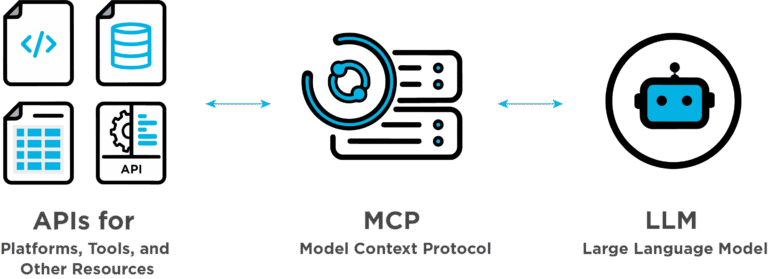
For marketers, the Ads MCP Server from Meta opens a more direct path from natural-language questions to campaign work. In the webinar, Kutsy organized the opportunity into three practical areas:
- Performance insights and analytics: Ask how spend, CTR, or another metric is trending; spot patterns; and combine Meta data with additional sources of context (e.g., Kochava MMP attribution, CRM).
- Creation: Create campaigns, custom audiences, catalogs, and related assets with more context from briefs, prior campaign learnings, or business goals.
- Debugging and troubleshooting: Ask What is wrong with this campaign, ad account, or catalog? and let an agent use the relevant tools to investigate at scale and solve problems faster.
The live StationOne demonstration made these possibilities concrete. Hamilton connected a real Meta campaign to a Slack conversation in which the team had agreed on campaign requirements. He asked the agent to verify whether the live campaign aligned with the planning conversation, then create a performance report.
The agent retrieved context from Slack, analyzed the Meta campaign, and surfaced two meaningful issues: The configured audience differed from the agreed age range, and the video asset the team intended to prioritize received scant delivery while static images received most of the impressions. The team was able to identify the underlying configuration issues and correct them within minutes.
This is what connected, agentic work can look like in practice. Rather than asking a marketer to compare a planning thread, Ads Manager settings, creative delivery, and performance data manually, the agent brought these inputs into one investigation. It did not replace the marketer’s judgment, but it found the relevant information faster and made it easier to act on.
A Practical Path to Agentic Adoption
 For most teams, the right starting point is not unrestricted autonomy, but a progression from insights and visibility to trusted action:
- Observe: Start by using an agent to retrieve data, summarize results, monitor trends, audit accounts, and identify anomalies.
- Recommend: Ask it to prioritize opportunities, explain tradeoffs, and prepare a next-best-action plan.
- Assist: Let it build campaign drafts, configure components, prepare reports, or package recommendations for review.
- Act with controls: Enable approved write actions and automate repeatable responses within defined permissions and governance policies.
One webinar attendee commented that they wanted AI to help them:
- Continuously monitor performance on their Meta ads
- Flag meaningful anomalies and opportunities
- Explain what moved and why
- Recommend the next action
- Keep budget changes and campaign edits human-approved at first
All of this is possible today using the Ads MCP server from Meta inside an AI workspace in StationOne. For a deeper technical walkthrough of the Ads MCP Server from Meta and how to use it, refer to How to Use the Ads MCP Server From Meta.
To get started right now, follow these simple steps:
- Visit Platform.StationOne.ai/Signup to create your free account.
- Tell the onboarding wizard that your goal is to manage your Meta campaigns, then follow prompts to:
- Join the Media Buying Workspace for Meta
- Add the Ads MCP Server from Meta and authenticate your Meta ads account
- Connect your organization’s approved LLM (e.g., OpenAI, Anthropic, Google)
- Once you’re in the workspace, activate the Daily Performance Monitor—the fastest path to your first useful result.
- Contact the StationOne team for assistance and/or a full tour.
Catch the Kochava + Meta Webinar On Demand
The webinar offers a practical view of how Meta AI connectors and StationOne can help marketers connect AI to the daily work of campaign management: analyzing performance, troubleshooting issues, building campaigns, coordinating across tools, and progressing toward governed automation. Access the webinar on demand here.
If you’re excited about building a more connected way of working that helps teams turn their questions about performance, creative, audiences, and measurement into timely, informed action, contact us for a helpful huddle. We can answer your questions and show you what’s possible.
FAQ
What is Model Context Protocol (MCP) in advertising?
Model Context Protocol (MCP) is an open standard that securely connects AI models to the tools, data, and systems needed to complete real work. In an advertising context, MCP enables an AI agent to work with approved sources such as an ad account, campaign data, and related business systems, so marketers can ask questions in natural language and take appropriate action from the same workflow.
Why is an AI harness important for marketing teams adopting agentic AI?
An AI harness provides the operating layer between users, AI models, and connected systems. It can bring approved models, MCP connectors, governance policies, and repeatable workflows into one environment. This matters because data privacy and governance is the top adoption concern among webinar poll respondents. A harness can help teams apply guardrails and control which tools or actions are available before information is shared with an external model or a campaign change is made.
Should marketers start with AI agents that can make campaign changes automatically?
Not necessarily—a practical path is to begin with read-oriented workflows: monitoring performance, summarizing data, auditing accounts, and diagnosing issues. Teams can then progress to recommendations and draft work, followed by approved write actions for repeatable workflows as they build confidence. This staged approach keeps marketers in control while they validate quality, permissions, and governance.
How does StationOne work with the Ads MCP server from Meta?
StationOne provides a governed, multi-model AI workspace where teams can connect to the Ads MCP Server from Meta and other approved tools such as Slack, Kochava, or internal data sources. This allows an agent to reason across the context marketers already use—for example, comparing campaign requirements discussed in Slack with a live Meta campaign—while organizational controls govern access, guardrails, and use of read or write tools. Meta continues to manage authentication and the permissions associated with a user’s Meta account.