CIMM and 4As map the confidence gap behind cross-media measurement
TL;DR Summary
Cross-media measurement confidence is the defining challenge facing senior performance marketers today. This is not because data is scarce, but because it doesn’t reconcile. In The Paradox of Plenty: Advertisers’ Perspectives on the State of Measurement (CIMM + 4As, March 2026), 39% of advertisers rate media performance as the single most important measurement domain. Yet confidence erodes when results require stitching systems together and reconciling “black box” methodologies. The practical problem isn’t lack of metrics but rather interoperability: mismatched definitions, incompatible identity frameworks, and manual reconciliation that slow decisions and weaken the internal narratives marketers need to defend their budgets.
 Somewhere between the third dashboard tab and the fourth competing attribution report, the nerve center goes dark—command becomes confusion.
Reach on one screen. ROAS on another. Attribution paths spidering across tabs. Attention scores pulsing like vitals on a monitor nobody fully trusts. Until the moment someone asks the question that actually matters: So what happened, and what do we do next?
The question lands differently when you’re holding 11 dashboards that don’t agree. And according to a new study from the Coalition for Innovative Media Measurement (CIMM) and 4As, it lands that way far more often than the industry’s measurement ambitions would suggest.
The Paradox of Plenty
The study’s title precisely names the condition: Advertisers have never been more data-rich—first-party data integrated with second- and third-party sources, identity graphs layered in, advanced analytics running across performance, attribution, brand impact, attention, and verification. The measurement toolkit has never been more complete.
And yet…

What the research actually surfaces isn’t a crisis of data quality but an organizational one: too many systems issuing competing verdicts, too many inputs demanding priority, no reliable mechanism for getting them to land on the same answer. One gaming executive interviewed for the study was direct: “We’re drowning in dashboards. We don’t need another report. We need a single version of reality.”
Performance optimization isn’t the problem. What breaks down is the next step: translating the optimizations into a coherent account of what worked, why it worked, and what to do with this information when the CFO is in the room. The dashboards never stop refreshing. But this isn’t the same as a clear answer.
The research reflects genuine scale and seniority: 197 experienced US brand marketers (director-level and above; annual marketing budgets exceeding $50 million) surveyed by NewtonX, supplemented by 16 deep-dive executive interviews spanning companies including Google, T-Mobile, Mastercard, Intuit, and Toyota.
Not One Advertiser…Three
One of the study’s most compelling presentations is a taxonomy of measurement orientation cutting across industry categories. The researchers identify three distinct advertiser profiles, each with its own relationship to confidence, speed, and rigor.
Fast Proof Advertisers—retail and financial services, primarily—run on observed outcomes. Conversions, ROAS, lift tests, same-day optimization signals: These are the metrics that carry weight internally because they’re the ones that don’t require explanation. When these signals go quiet or contradict each other, confidence doesn’t erode gradually—it drops. Everything, as one QSR executive put it, “ladders to ROI and incrementality.”
Comparable Proof Advertisers—CPG, pharma, auto, travel—operate in a world of indirect signals and long purchase cycles. Their measurement philosophy is built around consistency: If two channels can’t be compared in a shared framework, data from both becomes harder to trust. Opacity and nonstandard methodology are the enemies. Anything that makes the numbers harder to line up is a problem. An auto executive was direct: “We look for consistency. The most important thing is that we can compare channels in the same language.”
Future Proof Advertisers—technology and SaaS—want it all: the causal clarity of a fast proof operation and methodological rigor of a comparable proof one. They’re the most ambitious and, by the study’s own measure, the most frustrated, because the gap between what measurement currently delivers and what this cohort needs is wider here than elsewhere in the sample. One tech executive states, “If I can’t see the signal in near-real time, I can’t optimize against it, so the measurement is incomplete.”
The taxonomy cuts through what can look like random variation in advertiser behavior. The same tools produce disparate confidence levels depending on who’s running them. What counts as proof isn’t universal—it’s shaped by industry, operating model, and the internal audience a marketer ultimately must satisfy.
Where Confidence Lives—and Where It Doesn’t
The study maps cross-media measurement confidence across seven measurement domains. Media performance—CTR, CPA, ROAS, sales lift—is the clear leader: 39% of respondents deem it the single most important domain, and it functions as the universal boardroom metric for budget justification. Attribution metrics rank second at 20%; brand impact is third at 17%.
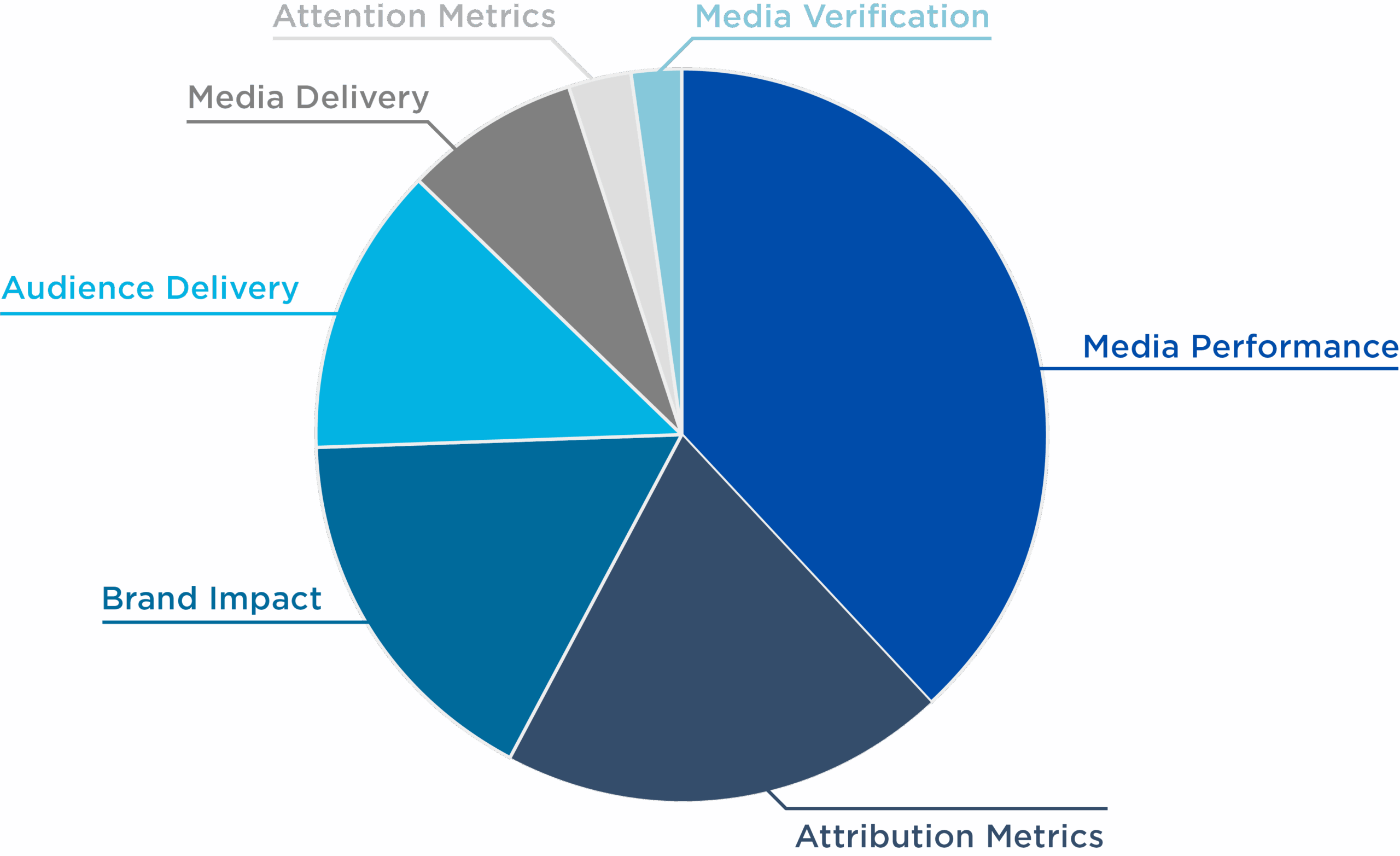
Share of advertisers rating media domains as “single most important”
The story gets instructive from here. Confidence in attention metrics, attribution, and verification is consistently tempered; these domains are repeatedly described in executive interviews as “black boxes.” Advertisers value them conceptually but are cautious about using them as primary decision inputs until methodology is more transparent and results more comparable across partners.
Confidence tracks with observability. Metrics you can count and explain in plain language survive internal challenges. Metrics requiring methodology footnotes before they can be explained face an uphill battle, not because the math is bad, but because the room stops listening before the explanation lands.
As Zuber Nosimohomed, President of TechEdge, frames it: “The future of measurement isn’t about replacing current signals—it’s about making them work better together. Hybrid measurement that combines panels and digital data brings clarity to a complex landscape, but its value depends on access, usability, and the ability to turn data into meaningful insights.”
Such framing cuts to the core of the study’s argument: Low cross-media measurement confidence isn’t about instrumentation—it’s integration.
Four Gaps the Industry Has to Close
The study identifies four structural gaps: definitional inconsistency across platforms, methodological opacity inside black-box systems, innovation outpacing governance, and infrastructure that can’t be joined. Each maps directly to a specific confidence failure surfaced by the research.
The first failure is foundational: no shared language. Without agreed definitions for what a reach point means, what an impression counts as, or how identity resolves across platforms, every cross-channel comparison starts from a different place. No way to build comparability atop that.
The second is transparency: Black-box systems that can’t be independently reviewed or calibrated against other vendors erode confidence fast, especially when results have to survive a finance team review. Advertisers don’t need simpler measurement; they need explainable measurement.
The third is governance: The vast majority of advertisers agree that AI will meaningfully reshape measurement in the next 3 to 5 years, but confidence in these innovations stalls without the shared standards and norms that allow experimentation to scale safely.
The fourth gap is structural. When 80% of advertisers are running simultaneously across streaming, social, search, broadcast, and digital video—each governed by its own definitions of what an audience is, what a view counts as, and how performance gets denominated—the problem isn’t channel-level. It’s what happens when you try to hold all of it in a single frame. The numbers don’t speak the same language, and no amount of additional instrumentation fixes a translation problem.
Bridging the gap: Kochava helps marketers close the last mile.
The gaps identified in the CIMM + 4As study—fragmented signals, incompatible definitions, outputs that don’t reconcile—are the exact problems Kochava’s omnichannel measurement platform is designed to solve.
One practical answer is unifying MMM and last-touch attribution into a coherent measurement story. Here’s how Kochava approaches it.
If your stack is producing data but not decisions, let’s chat.
The study’s overall verdict is steadier than the confidence data might suggest. Nine in ten advertisers don’t anticipate severe measurement barriers over the next 3 to 5 years. Cross-platform measurement, signal loss, and incrementality register as friction, not existential threats. Advertisers have learned to live with it. They’ve rewired workflows, recalibrated expectations, and made fragmentation something close to routine.
What they haven’t solved is the last mile: the ability to take multiple measurement systems and produce one coherent story they can take upstairs. As one advertiser puts it: “The data is there. The question is what counts.”
“The future of measurement isn’t about replacing current signals—it’s about making them work better together.”
Zuber Nosimohomed, President, TechEdge
 The Full Picture
The Paradox of Plenty goes deeper on advertiser confidence by sector, distinct measurement of first-party-data-led organizations, role of agency vs. in-house media models for workflows, and specific expectations advertisers carry for AI-enabled and privacy-preserving infrastructure. For senior performance marketers looking to rebuild cross-media measurement confidence within a fragmented ecosystem, it’s an operational map. As a cosponsor of the study alongside Nielsen and TechEdge, Kochava is making the executive summary available for download. Get your copy now.
The nerve center never has to go dark. But the signal becomes an answer only when the systems behind it finally agree.