WWDC 2026, ATT opt-in trends, SKAN adoption, Apple Ads, and more
TL;DR Summary
Five years after Apple introduced App Tracking Transparency, only 21% of iOS app marketers describe themselves as confident in their iOS attribution, according to a 2026 survey by Kochava Foundry. SKAdNetwork adoption remains well short of its potential: 33% of marketers have not implemented it at all, and AdAttributionKit, Apple’s next-generation attribution framework, has negligible traction despite being in market since 2024. Meanwhile, 69.7% of iOS users who are shown an ATT consent prompt accept it, yet most apps still do not prompt, leaving a significant opportunity for deterministic attribution unclaimed. In this article, Grant Simmons, VP of Kochava Foundry, breaks down what the data shows and what iOS app marketers should prioritize now.
Watch the related webinar on demand here.
WWDC 2026 came and went without meaningful updates to AdAttributionKit (AAK) or the App Tracking Transparency (ATT) framework. Industry analyst Eric Seufert, who has covered Apple’s advertising privacy changes closely since their rollout, noted that despite pre-WWDC speculation, Apple did not unveil new disruptive privacy features or updates to AdAttributionKit. What dominated the conversation instead was Apple Intelligence and AI. For app marketers who have spent the last 6 years adapting to the realities of ATT, the absence of news on the attribution front was itself notable—and in some ways clarifying.
Rather than speculate about what Apple may or may not be planning, my team at Kochava Foundry thought this a good moment to share what we’re actually seeing in the market. We recently surveyed a cohort of mobile marketers and app owners on their iOS measurement practices, and when you view that data alongside what we see in attribution patterns across our platform, a clear picture emerges.
📺 Watch on demand: If you’d rather hear this research walked through live, all of it was covered in a recent webinar. Access the on-demand recording.
Five Years of ATT: Where the Attribution Landscape Has Landed
When Apple announced App Tracking Transparency (ATT) at WWDC 2020 and enforced it with iOS 14.5 in April 2021, the premise was straightforward: Give users control over cross-app tracking, route privacy-safe attribution through SKAdNetwork (SKAN), and allow Apple Ads (then Apple Search Ads) to function as a deterministic measurement channel for those willing to invest in it. In theory, a coherent system.
What happened in practice is a more complicated redistribution. Before iOS 14.5, the IDFA accounted for 42% of total iOS attributions. It was the connective tissue for cross-app tracking and measurement, a reliable identifier the whole ecosystem had built around. When iOS 14.5 dropped and Apple pushed the OS update broadly, the IDFA tumbled almost overnight. The cliff was steep, and it was fast.
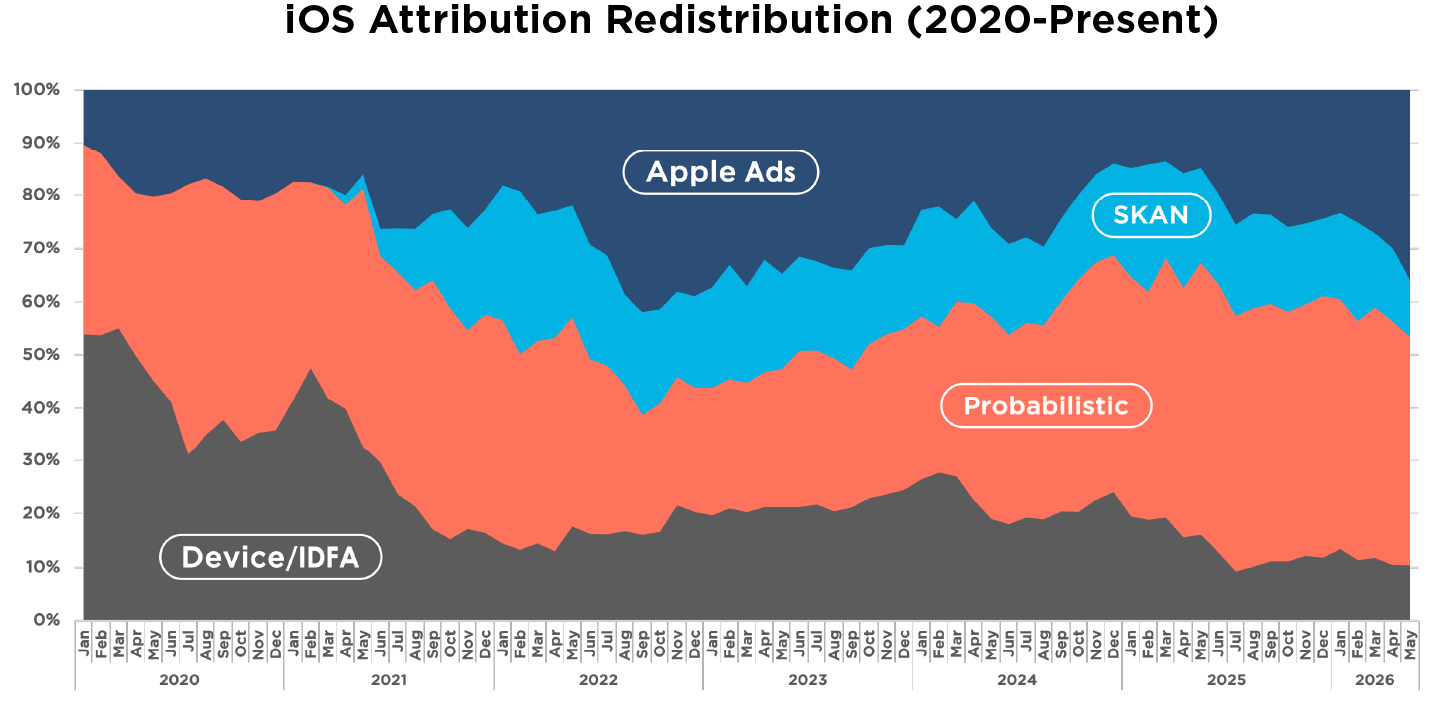
Based on Kochava’s attribution data as of mid-2026, about 10% of iOS attributions are now device-level and consented. SKAN accounts for 11%. Apple Ads has grown considerably, now representing 36% of iOS attribution volume, largely because it remains the only channel where a deterministic keyword-to-device association is possible without ATT opt-in. The remaining volume flows through aggregate and modeled approaches.
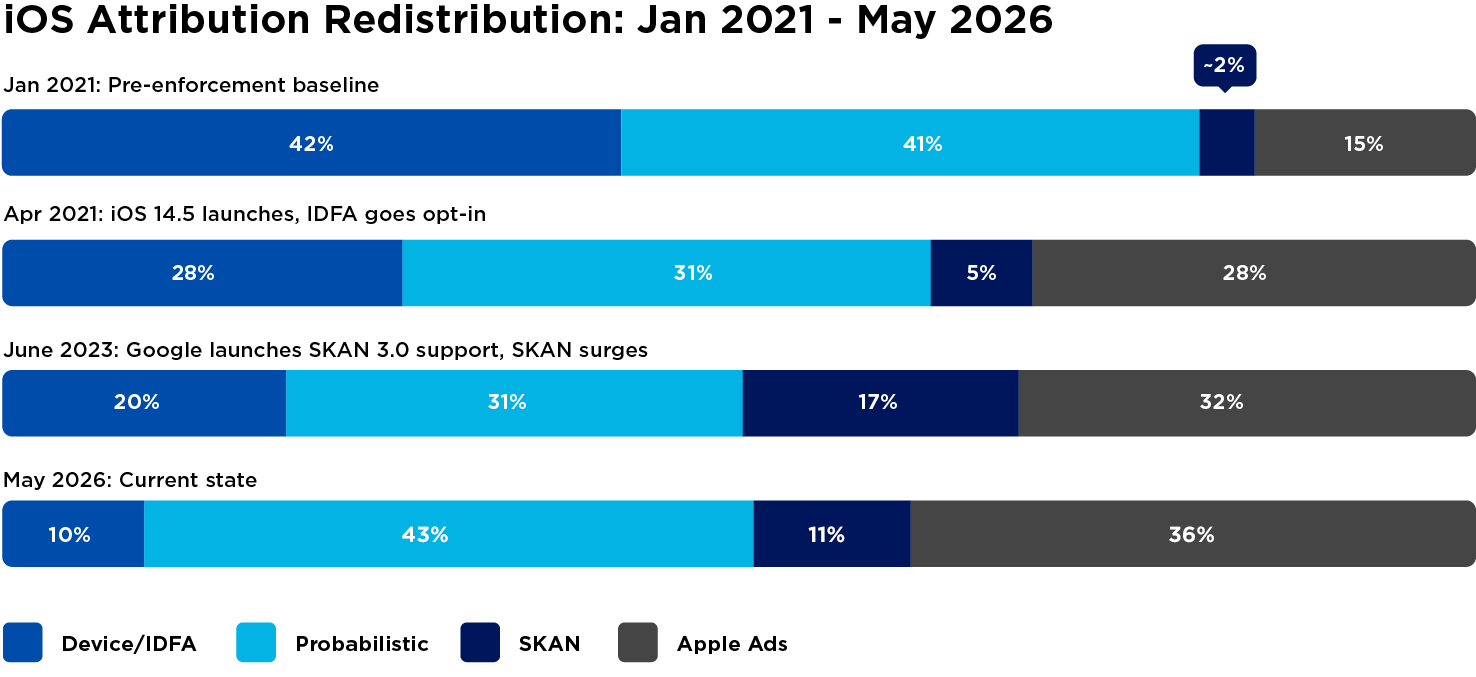
The growth of Apple Ads is a rational market response. When deterministic measurement options narrow, spend concentrates where measurement remains viable. We observe consistently that the vast majority of Apple Ads spend consists of brands bidding on their own brand terms. This is measurable. Whether it is incremental is a separate question, and one worth asking.
One vertical disproportionately affected by all of this is gaming. Ad-monetized gaming depends on real-time feedback to optimize eCPM and fill rates. SKAN’s postback delays disrupt the loop. Publishers cannot dynamically adjust which ads to serve as they once could. For mid-tier game developers especially, who don’t have the volume to clear crowd anonymity thresholds reliably, it has been a genuinely difficult 5 years.
Survey Says: iOS Confidence, SKAN Adoption, and a Budget Paradox
We sent our survey to iOS app marketers. The headline finding: Only 21% of respondents describe their understanding of iOS attribution as comprehensive and confident. Forty-eight percent say they have a basic understanding with unresolved blind spots. Fourteen percent have no clear picture of how iOS attribution works.
This low confidence is not slowing investment. Forty-seven percent of respondents increased their iOS media budgets over the past 12 months, with 35% increasing significantly—more than 20%. iOS remains strategically important: 57% of respondents say it is their primary platform, driving the majority of their high-value users. iOS users observably spend more time and money in-app. This makes the platform worth the measurement complexity, even when the complexity is real.
More spend, less measurement confidence. This is the current state of iOS for a large share of the market. And frankly, it represents an opportunity for those who do the measurement work properly.
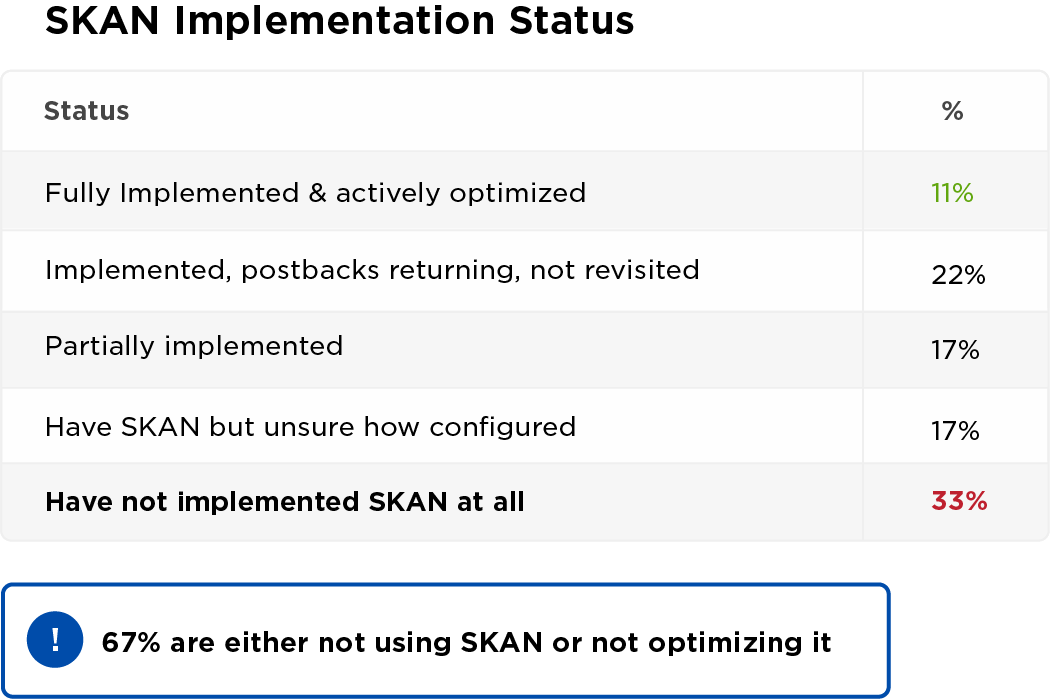
On SKAdNetwork specifically, the data confirms what my team sees in our consult work. Thirty-three percent of respondents haven’t implemented SKAN at all. An additional 17% have it in place but are not sure how it is configured. Only 11% describe themselves as fully implemented and actively optimizing their setup on a regular basis. Meanwhile, 67% have experienced reporting gaps or anomalies attributable to SKAN privacy thresholds (e.g., crowd anonymity delays, withheld source app IDs, delayed postbacks).
The version-level data makes the adoption story even more concrete. SKAN 4.0 was released in October 2022, bringing three conversion windows, up to five postbacks, and crowd anonymity tiers that allow for more granular data at scale. As of mid-2026, SKAN 4 is finally reaching majority adoption. SKAN 1 and SKAN 2 are effectively gone. AdAttributionKit (AAK), the next generation of SKAN, registers as negligible.
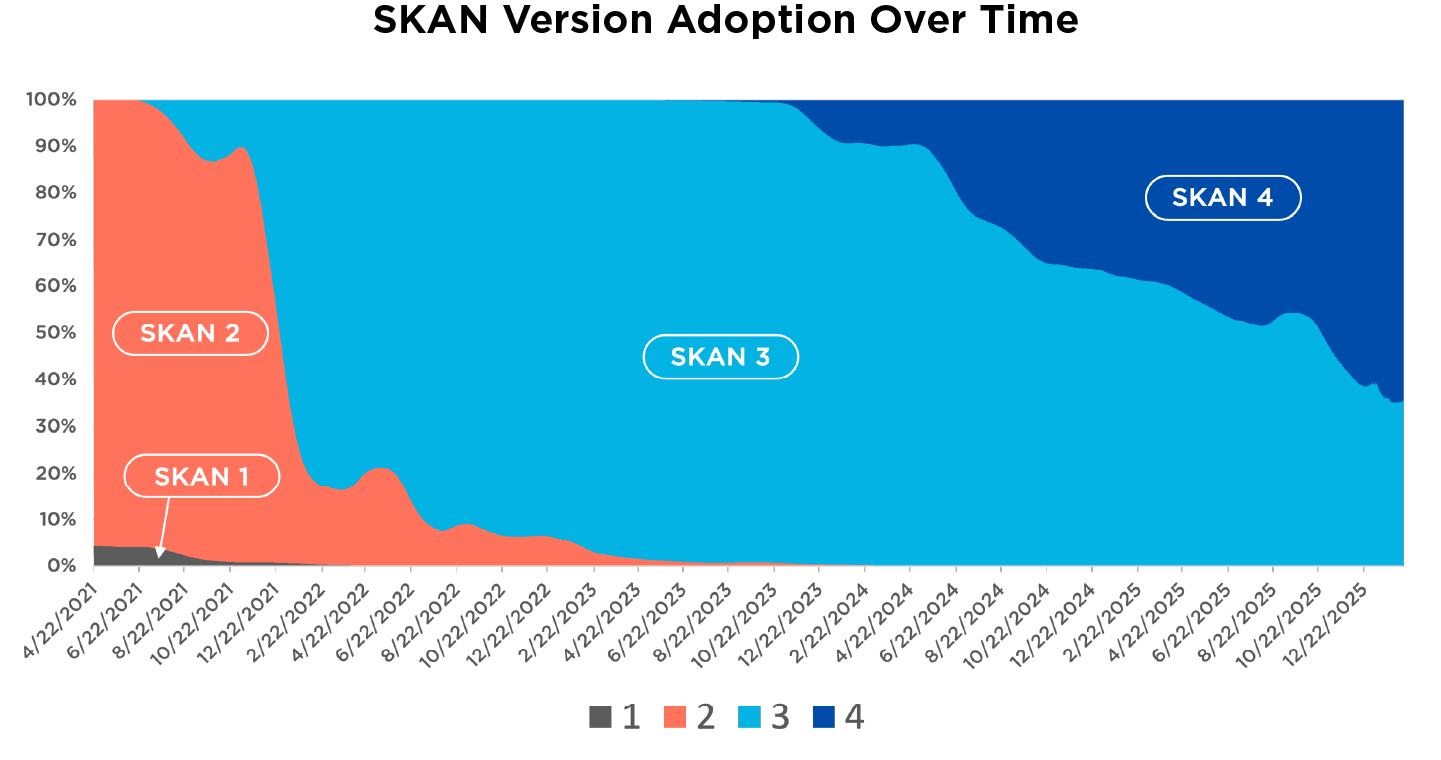
The pattern is consistent across every version transition: Even meaningful improvements to the framework take years to gain adoption. The bottleneck is typically on the publisher side. Publishers are historically the long pole in version migrations, from SKAN 2 to 3, from 3 to 4, and now from 4 to AAK. Until publishers implement, advertisers cannot benefit, regardless of what their SDK supports.
AAK has features worth paying attention to. Reengagement attribution is a real capability that has been largely absent from the iOS ecosystem. The anti-fraud measures are substantive. Deep linking support is meaningful for retention-focused campaigns. I am genuinely optimistic about what it can do. But all this has been available since March 2024, without any meaningful adoption. Twenty-seven percent of respondents in our survey hadn’t heard of AdAttributionKit. Only 7% have an active plan and are testing its features.
Learn more about AAK here.
ATT Prompting: A Missed Opportunity for Many
One of the more striking findings from our research involves ATT consent itself. As of 2026, 69.7% of iOS users who are shown an ATT prompt accept it. This rate has climbed steadily since ATT launched, when acceptance among prompted users sat around 37%. It crossed 50% for the first time in September 2024, and now approaches 70%.
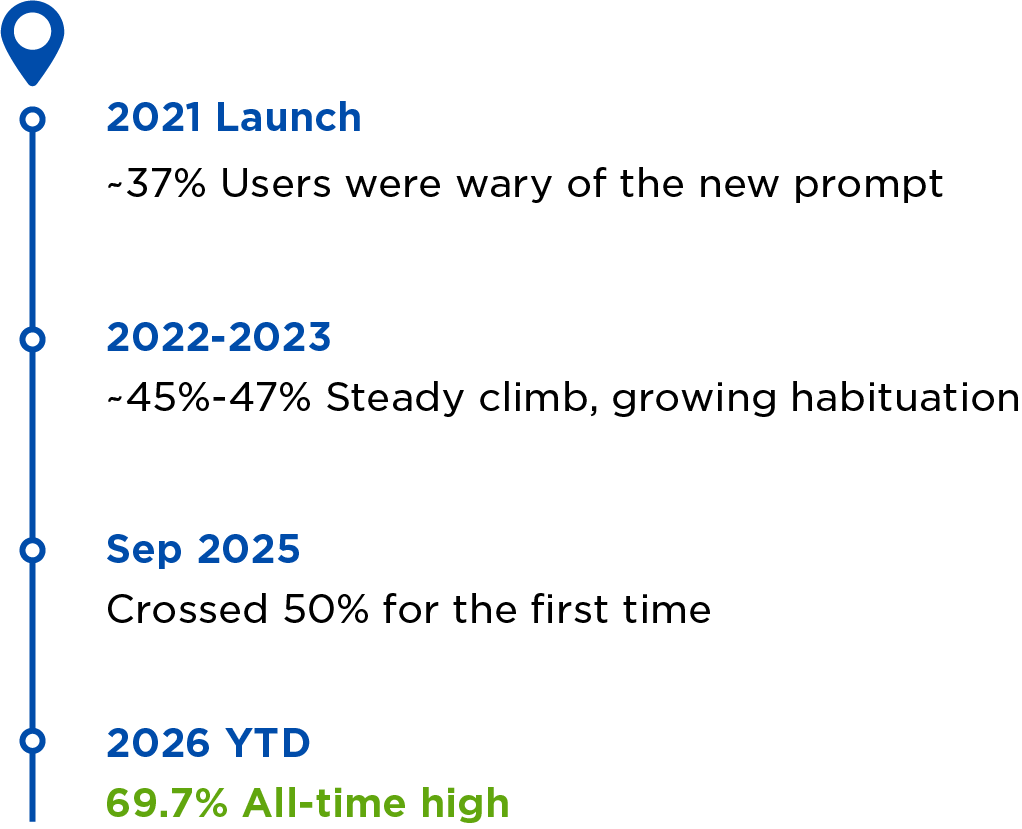
Part of what is driving this is simple habituation. Anyone who has spent time browsing in Europe has experienced the effect: The first dozen GDPR cookie prompts feel intrusive, then they become background noise, and eventually clicking accept is reflexive. iOS users have now seen the ATT prompt hundreds of times across hundreds of apps. The friction has genuinely diminished.
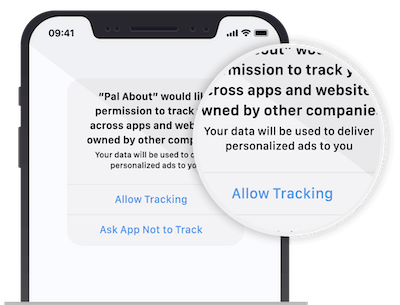
Here is the problem: Only 2% of iOS installs are being prompted in the first place. Our survey found that 24% of respondents haven’t implemented an ATT prompt at all. Another 36% use only Apple’s default system prompt without a custom pre-prompt experience. When nearly seven in ten users who see the prompt accept it, the barrier to consented attribution is not user reluctance. It is the absence of a prompt.
There is also a measurement quality argument beyond just attribution volume. Even a 10–20% consented user base provides a reliable deterministic population for modeling and extrapolation. Deterministic is deterministic—you are not estimating. That seed population has real value for understanding downstream user behavior across the rest of your iOS traffic.
A well-designed pre-prompt experience, one that clearly explains the value exchange before the system dialog appears, can meaningfully move consent rates. This is not a workaround, but standard UX practice.
Among respondents without a defined strategy for non-consented users, 19% are unsure how their MMP handles those users at all. That’s 90% of your iOS traffic with no defined approach. The gap is worth closing regardless of which SKAN version you are running, if you’re running one at all.
Building a Measurement Strategy for the State of iOS
iOS is worth it. That’s the bottom line, even after 5 complicated years since the rollout of ATT in April 2021. The platform is not going away—56% North American handset penetration, flat for 4 years, with iOS users consistently spending more time and money in-app than their Android counterparts. The measurement is harder. The audience is still there.
The marketers in the strongest position are not those who have found a single clean signal. They are the ones who have accepted that no single signal solves it, and have built a layered approach based on three standards:
- Optimize for ATT consent where available.
- Build a SKAN implementation you actually understand and can act on.
- Use aggregate measurement methods such as marketing mix modeling to bring structure to the large share of iOS activity that cannot be resolved at the individual level.
No two brands’ publisher relationships, vertical dynamics, or conversion models look exactly alike. That’s part of what makes this genuinely hard, and why the work tends to be custom. My team at Kochava Foundry has spent the last 5 years working through these problems with iOS app marketers across verticals and spend levels. The problems are solvable. If this is something your organization is actively wrestling with, we are happy to compare notes.
📺 Watch the full webinar: We covered all of this in depth in 5 Years Post-IDFA: iOS App Marketing & WWDC 2026, a Kochava webinar. Hear the survey findings unpacked, see the SKAN version adoption data, and get into the weeds on ATT opt-in rates and what to do about them .Access the on-demand recording.
For a SKAN consult, iOS app marketing guidance, and more, request a huddle with me or my team.

About the Author
Grant Simmons is VP of Kochava Foundry, the strategic services and client analytics division of Kochava. He has worked with iOS app marketers across verticals since the early days of mobile—navigating every major platform shift from the IDFA era through the rollout of App Tracking Transparency, SKAdNetwork, and AdAttributionKit. Grant and his team have conducted hundreds of SKAdNetwork consults, helping app marketers optimize conversion models, audit publisher relationships, and develop measurement strategies that function across both consented and non-consented iOS traffic. He is a regular speaker on iOS app marketing, ad fraud prevention, mobile growth, and applied measurement strategy. Grant on LinkedIn