 Discussing AI, Transformation, Integration & Collaboration at the 12th Annual Summit
Just like that, the 12th annual Kochava Summit is a wrap. This year’s theme was Shaping the Future of Performance Together, with CEO Charles Manning drilling home three key pillars: transformation, integration, and collaboration—as we collectively face a time of rapid evolution in digital advertising and society as a whole.
Be sure to check out summaries and fun photos from Day 1, Day 2, and Day 3 wrap-up posts on LinkedIn.

Catch the Next in Media podcast recorded live on the Summit stage with host Mike Shields and special guest Charles Manning.
Before diving into six key takeaways from Kochava Summit 2026, a special thanks is due to all of our sponsors, clients, partners, and friends who made the trek to the beautiful resort town of Sandpoint, Idaho. Every year in the lead-up to the event, the Kochava team eagerly monitors the local weather forecast, hoping healthy snowfall provides fresh powder for closing ski day on Schweitzer Mountain. While we’ve endured the same record-low snowfall as the rest of the west, there was enough for an amazing day on the slopes, with sunshine and views for miles.
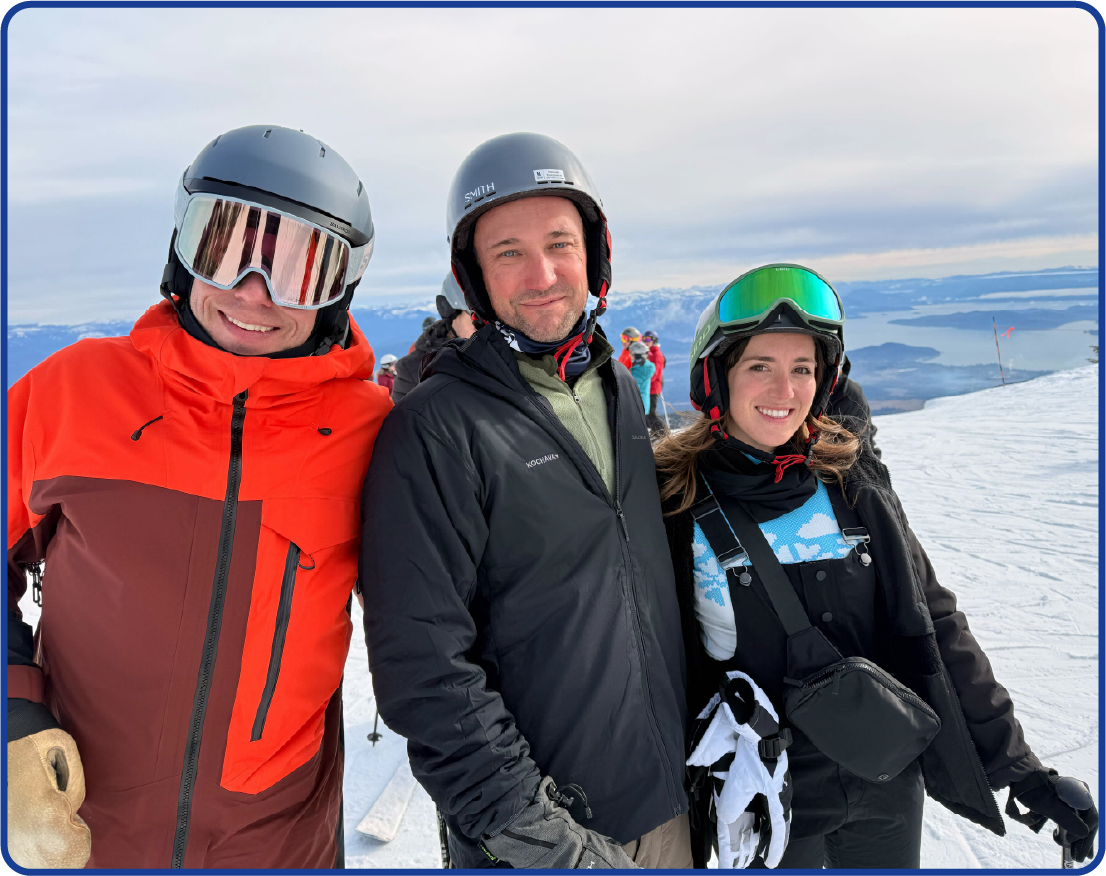
From left to right: Matt Gillis (Kochava), Mike Hood (NBCUniversal), Allison Tumas (Versant Media/Fandango)
Nonetheless, as I sit here writing on Monday morning after Summit week… I can’t help but mention the irony that we’re in the midst of a beautiful morning snow in town with two fresh feet of powder expected atop Schweitzer Mountain this week. Hopefully, next year, such a snowstorm can show up prior to Summit.
Thank You Kochava Summit 2026 Sponsors

Now, let’s unpack the top six takeaways from this year’s event:
Takeaway 1: Embrace Transformation, Integration & Collaboration
Takeaway 2: Constraints Breed Imaginative Innovation
Takeaway 3: Build Your AI Bridge and Be Prepared to Stand Under It
Takeaway 5: Driving Outcomes Together—Kochava Announces Atlas Performance
Takeaway 6: Measurement Feels Broken; It Doesn’t Have To
Takeaway 1: Embrace Transformation, Integration & Collaboration
Transformation
Manning’s Summit 2026 keynote presentation emphasized the transformation adtech is currently experiencing, drawing comparisons to how airline reservations transformed from 1945 to the present day. The airline reservation process in 1945 was so manual and cumbersome that it served as a growth chokepoint for the entire industry. Only transformative, technological innovation unlocked escape velocity for air travel at scale.
Transformation in Airline Reservations
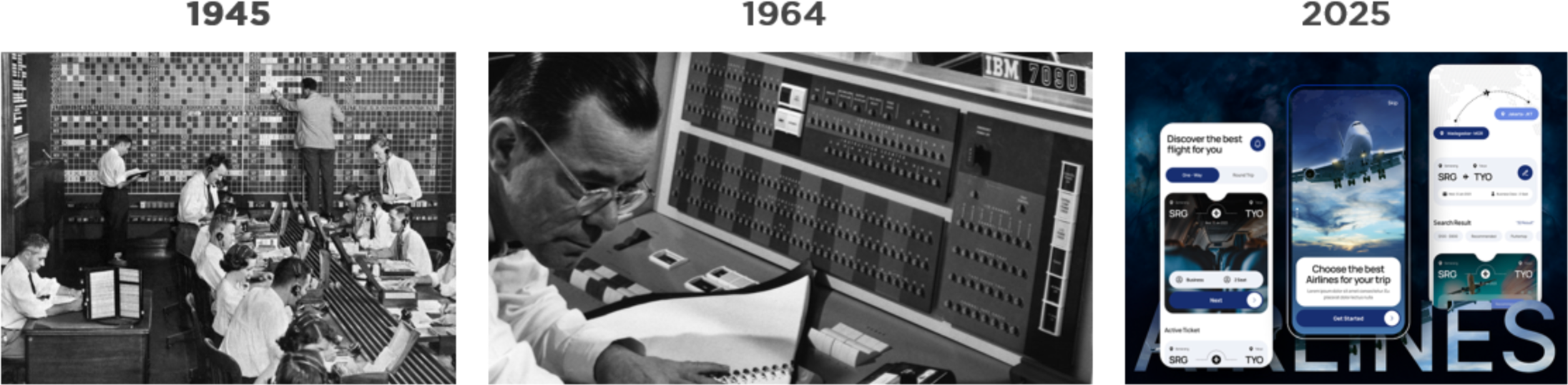
As the endless possibilities of AI stare us in the face, the extent to which we transform our daily processes and workflows is limited only by our imagination. Whereas airline reservation tech evolved across decades, AI is transforming adtech seemingly overnight. Manning invited attendees to challenge themselves and think about transformation within their own organizations.
Transformation Challenge Questions
- Where does your organization need to transform?
- How can you leverage learnings from Summit 2026 to make a plan?
- What can Kochava do to drive transformation with you?
Integration
We all confront the reality of silos across teams and departments, channels and platforms, tools and systems. It is only where silos end that true performance can begin. Manning expressed this as a foundational philosophy behind Kochava’s AI strategy with StationOne. Our mission isn’t just to create AI features within the Kochava measurement or MMM platforms, but rather to enable integrative connection with the complete universe of tooling that our clients and partners leverage across their marketing tech stacks.
In an age when product development advances to light speed via AI, integration (e.g., certified integrations, badged partnerships, MCP connectors) becomes the real difference makers.
The audience was again challenged to consider their role in facilitating integration:
Integration Challenge Questions
- What silos exist today across datasets, tools, departments, and teams in your org?
- What are you currently doing to support integration?
- What can Kochava do to drive integration for/with you across your cross-functional organization (workflows/data/tools)?
Collaboration
The future of performance can’t truly be shaped unless we do it together in collaboration. Manning harkened back to a recent LinkedIn post, where he shares what he loves about the collaborative atmosphere Summit creates: It’s a place where people building the future of advertising can slow down just enough to actually talk to one another and develop community together. The collaborative spirit is found in the…
- Early conversations to get customers and partners sharing their successes and challenges
- Between-panel sidebars where new relationships are forged
- Dinners where ideas are challenged, refined, and sometimes completely rethought
- Post-dinner moments around a fire, brainstorming new ways to grow together
- Stories about people doing business together because they met at Summit
Collaboration Challenge Questions
- How do you break down your operations for tomorrow—made up of real and virtual team members?
- In what ways can you collaborate to set and achieve the new definitions of success in the AI era?
Takeaway 2: Constraints Breed Imaginative Innovation
After his opening keynote, Manning was joined onstage by Simon Sproule, Founder of Newport Communications. Sproule’s time in the Formula 1 racing world has afforded him a treasure trove of insights into how teams adapt and innovate rapidly under time and resource constraints. Cost caps in F1 racing established financial regulation that limits how much each team can spend in a season. These were introduced in 2021 to improve competitiveness and reduce runaway spending by the biggest teams—leveling the performance playing field for all.
Expenses that fall under the F1 cost cap include:
- Car design and development aerodynamics
- Manufacturing and assembly of the cars
- Performance operations, garage equipment, data systems
- Team salaries
- IT and software related to car performance simulation systems
- Logistics related to car operation
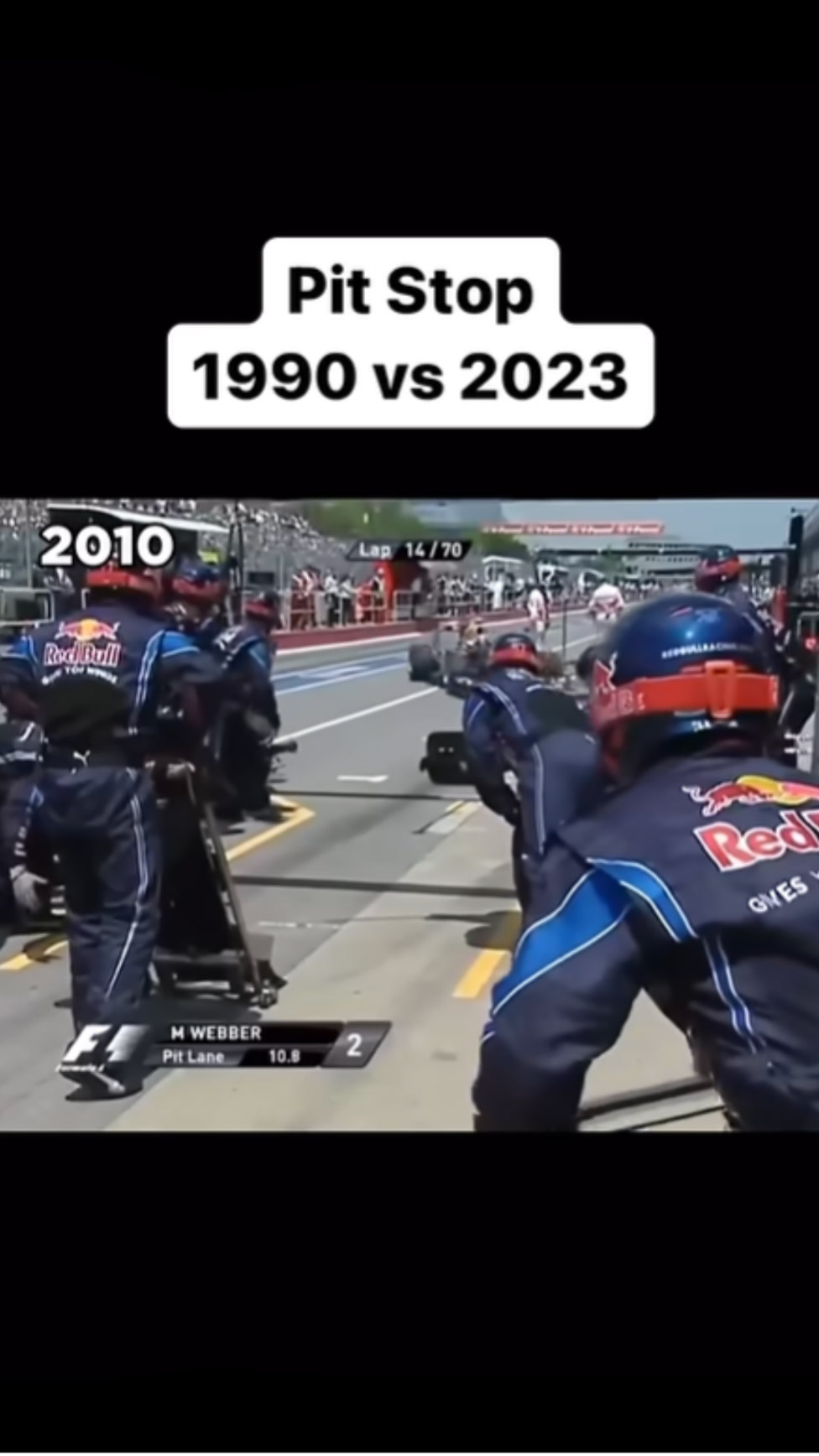
Under these constraints, F1 teams have become more innovative, continuing to advance performance and speed. For example, pit stops averaged over a minute in the 1950s, 10–12 seconds in the 1990s, and under 2 seconds today. Even after cost caps were introduced, teams micro-tweaked performance advantages wherever they could, leaning into the importance of physical and mental fitness, sleep, diet, and team building. Every team now employs physical therapists and performance coaches.
FUN FACT
A typical F1 pit crew has 22–26 mechanics:
- 4 on the wheel guns
- 4 removing wheels
- 4 fitting wheels front & rear
- Jack operators
- Stabilizers/wing adjusters
- Release person
This video compilation from YouTuber Tobi Lawal shows pit stop times spanning 1993 to 2023.
F1 Pit Stop (1990-2023) | WATCH HOW THE TIME DECREASES AND INCREASES |
Manning and Sproule zoomed in on the parallels to adtech, where marketers face similar constraints as they confront tighter advertising budgets and smaller teams, all while being asked to increase performance and growth. It is in the face of such constraints that our imagination can flourish, leading to innovations that may never have materialized in an environment where budget and/or team size is plentiful. Now, in the age of AI, the question is how you can individually, as a team/department, and as an organization harness agentic AI to achieve levels of efficiency, speed, and performance previously unimaginable.
Takeaway 3: Build Your AI Bridge and Be Prepared to Stand Under It
Naturally, AI was a hot topic at Kochava Summit 2026. Agentic AI has seemingly endless potential to transform the way we live and how we work. Kochava leaders shared a host of use cases where the team already leverages AI for marketing workflows, ad ops team playbooks, software development lifecycle (SDLC) acceleration, and much more. Against this backdrop, Manning shared a story his mother often related to him about Roman architects.
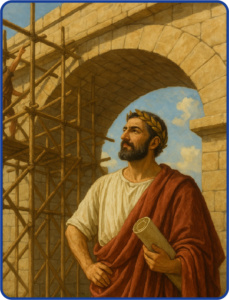
In the sprawling expanses of the Roman Empire, architects and builders were required to stand under their newly constructed arches and bridges as the scaffolding was removed. This act was not merely ceremonial; it was a profound demonstration of their confidence in their engineering and craftsmanship. If the structure failed, they would bear the consequences. This unspoken vow of accountability underscored the integrity of their work, ensuring that every stone was impeccably placed, every calculation meticulously verified. It was a testament to their unwavering commitment to quality and durability.
Now, fast forward to the digital age, where AI is the new frontier of human ingenuity. The architects are the developers, engineers, marketers, and other everyday professionals who design and build AI agents. These modern-day builders must also stand under their creations, metaphorically speaking. In the age of AI, the output of these agents can be vast and varied, often generated from simple prompts and minimal input. The ease with which one can produce massive quantities of information is remarkable, yet it brings with it significant responsibility.
The true measure of an AI agent’s value lies not in the volume of its output but in its ability to perform its intended function effectively and correctly (meaning no “AI slop”). Like the Roman architects, those who create AI systems must be willing to stand behind their work, ensuring that it meets the highest standards of reliability and ethical consideration. The challenge is to navigate the delicate balance between innovation and accountability, ensure that the AI we create serves the greater good, and be prepared to answer for its actions, as the Romans did for their bridges. Only then can we truly harness the potential of AI, standing confidently under the structures we build, ready to answer for their impact on our daily work, our colleagues, and our organizations.
The vision for StationOne, the integrative AI hub by Kochava, is to give our clients, partners, and adtech professionals a solid foundation to build AI agents and workflows, fully interconnected with the tools, standards, and context underpinning our industry. To embark upon your agentic AI journey with Kochava, request an invite to our closed StationOne beta.
Takeaway 4: CTV Is TV
In a Summit panel session entitled Cross-Platform Outcomes and CTV’s Full-Funnel Impact, Jackelyn Keller (Founder and Principal Consultant at Jackwell Partners) helmed a panel of industry experts discussing CTV’s role in driving cross-platform performance. While the industry has been talking for years about CTV’s evolution from a brand medium to its pivotal performance marketing potential, it’s a shift that requires constant reminding.
Justin Rosen (SVP Data at Ampersand) elicited a jovial crowd reaction when he declared “CTV is TV.” (See his related LinkedIn memory moment here.) CTV now has the power to drive the same reach linear TV did in its heyday, while affording a level of targeting precision traditional TV marketers would’ve only dreamed of back in the day.
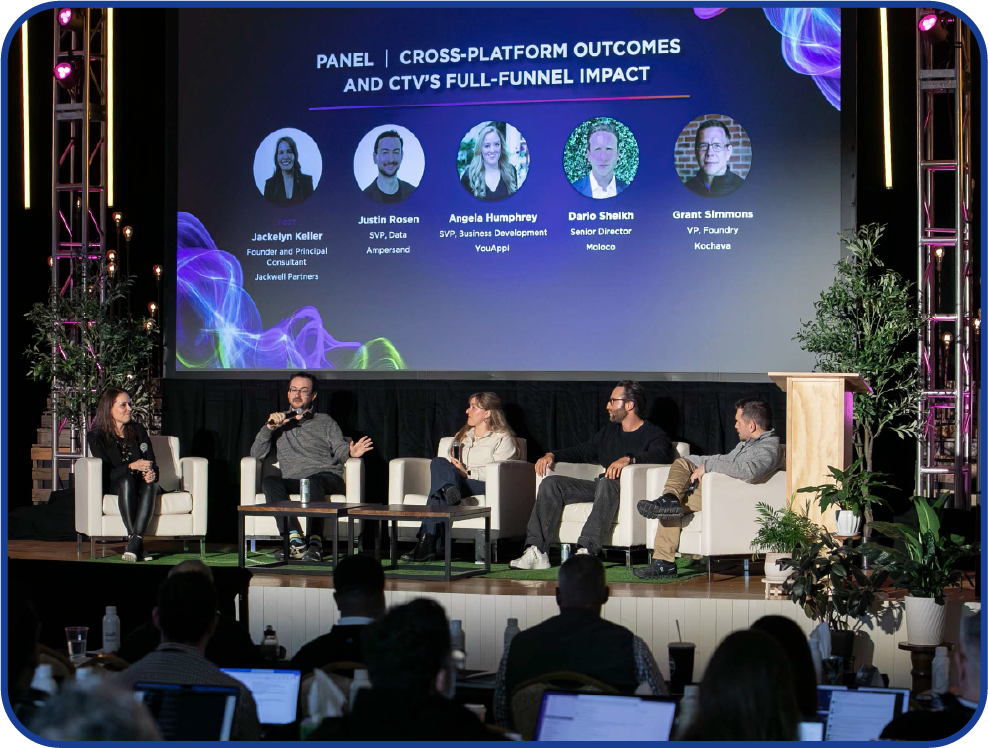
Grant Simmons (VP Foundry at Kochava) shared Kochava research showing marked lift in user quality post-install across popular app verticals. When a user’s path to app install includes CTV exposure alongside other mobile-first channels (e.g., search, social, display), users complete significantly more in-app events (e.g., registration, purchase, free trial start) than users exposed to only mobile-first channels.
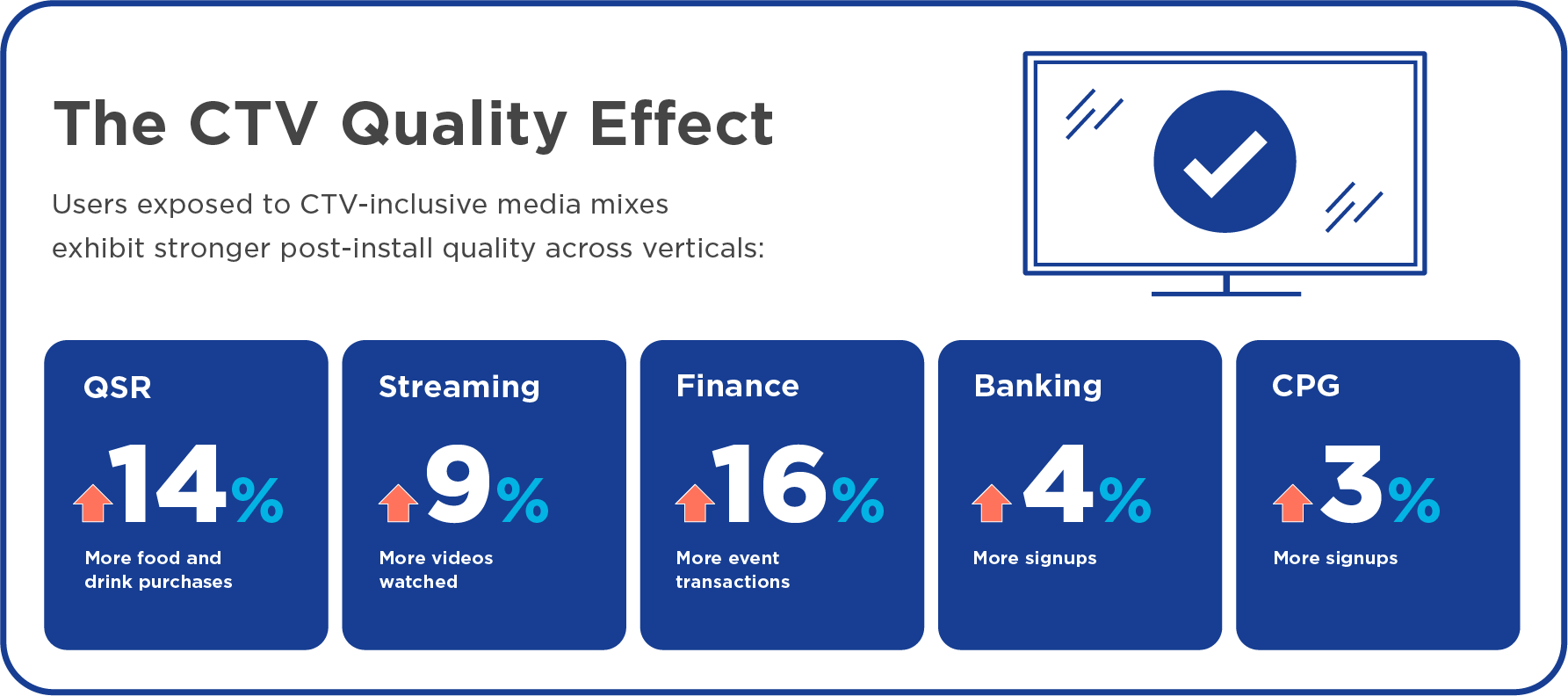
Based on Kochava data science analysis of 10M+ app installs in Q2 2025. Analysis compared post-install KPI for users served CTV alongside other media channels vs. users touched only by mobile ads.
App marketers are catching on to this reality, reflected in Kochava’s seeing a 10% increase in total app conversions attributed to CTV media between Q2 2024 and Q2 2025. CTV is the fastest-growing attribution source category by share of total app conversion attributions.
If you’re looking to take CTV seriously in 2026, contact us.
Takeaway 5: Driving Outcomes Together—Kochava Announces Atlas Performance
Grant Cohen, GM of Publisher Solutions at Kochava, took the stage to formally announce the launch of Atlas Performance by Kochava (see press release).

Since 2020, Kochava has provided supply-side outcomes measurement solutions under the name Kochava for Publishers. The launch of Atlas Performance marks the evolution of Kochava supply-side solutions into a comprehensive Supply Performance System (SPS) that supports outcomes measurement and outcomes optimization across all channels and outcome types.
Cohen showcased the new Data Connections Hub within Atlas Performance, which empowers premium publishers and platforms to connect the dots between their ad inventory and an entire marketplace of outcomes that matter for their advertisers. Data Connections Hub supports both upper-funnel and lower-funnel outcome types across mobile, web, and CTV, plus in-store visitation and consumer purchases. Data Connections Hub acts as the universal integration layer that enables publishers to say yes to every advertiser, every vertical, every outcome type—without custom engineering work blocking revenue growth.
Cohen was joined on the stage by key partners from NBCUniversal, Fetch, and Versant Media/Fandango to discuss key areas of collaboration:
- Cohen and Ryan Woodhatch (Sr. Director Sales & Data Partnerships at Versant Media/Fandango) touched on a partnership enabling media & entertainment brands to optimize against theatrical movie ticket sales via Fandango as an outcome.
- Emily Starer-Wallace (Data Product Strategy & Partnerships at Fetch) unpacked the scope and scale of Fetch’s receipt scan data and how it can be used via Kochava to optimize campaigns for brands across ecommerce, quick service restaurants, and other D2C verticals.
- Mike Hood (SVP Partnership Product Sales at NBCUniversal) opened up about the great work NBCUniversal is doing with Kochava to help advertisers realize and prove the outcomes they expect to drive when advertising across the premium lineup of streaming content spanning the NBCU universe.
To learn more about Atlas Performance, visit kochava.com/atlas-performance.
Takeaway 6: Measurement Feels Broken; It Doesn’t Have To
The challenges and fragmentation in marketing measurement continue to be a thorn in the side for many a marketer. In a candid session entitled Why Measurement Feels Broken, Gary Danks (GM, AIM at Kochava) ripped off the Band-Aid and explored how he observes agile organizations changing the way they think about measurement in today’s complex environment. Rather than relying on the illusion of certainty that deterministic, user-level attribution once provided, the most-successful teams understand that measurement has always been imperfect—and recent privacy changes and platform restrictions have simply stripped away the illusion.
Effective teams focus on three core principles:
- Truth lives in the total business outcome
Rather than obsessing over proving which channel “won,” successful teams focus on the overall numbers that matter for the business—total revenue, total CPA—because these are objective and meaningful to business health. - Direction matters more than channel precision
These teams track the overall trend line: Are results moving in the right direction, and are the business’s key metrics improving? They do not get bogged down micromanaging attribution at the channel or conversion level, recognizing that some noise and ambiguity are inherent in marketing measurement. - Different tools answer different questions
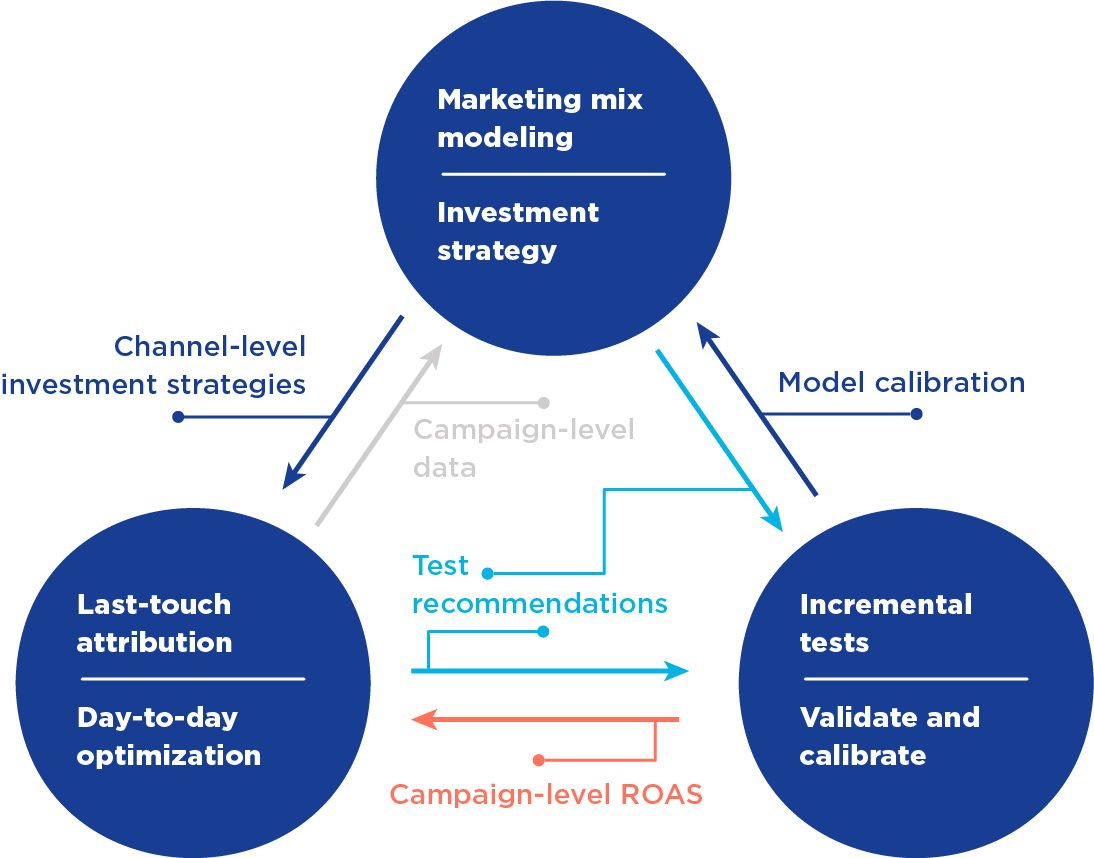
There’s a clear understanding that no single solution or methodology can solve the entire measurement puzzle. Teams use a combination of marketing mix modeling (strategic, ecosystem-level insights), last-touch and multi-touch attribution (tactical, day-to-day optimization), and incrementality testing (as a referee when models conflict or outcomes are unclear). Each methodology has its strengths and weaknesses, but together, they triangulate reality and compensate for one another’s limitations, as the diagram shows:
With this principle-based framework, measurement stops feeling broken; it becomes a truly useful compass in guiding the business. The underlying message: Sustained progress comes from focusing on total results, prioritizing overall direction over granular precision, and leveraging multiple measurement tools in collaboration rather than chasing the impossible standard of perfect measurement. Contact us for a further discussion on leveraging these principles in your organization.
Looking Onward to Kochava Summit 2027
Whether you’ve been to every Kochava Summit, attended this year for the first time, or aspire to make your inaugural trek to Sandpoint in 2027, the Kochava Summit is a one-of-a-kind experience. Be sure to visit kochava.com/events/summit to request more information, ask about 2027 sponsorship opportunities, or just browse this year’s insights-packed agenda.
To discuss Kochava 2026 takeaways or consult with Kochava experts, contact us.
Stay in the know on all things Kochava. Subscribe to our newsletter.